


Sheet Metal Fabrication: Process, Materials & Parts Explained
Sheet metal fabrication is the process of turning flat metal sheets into functional parts through cutting, bending, and joining. It is one of the most widely used manufacturing methods, producing everything from enclosures and brackets to chassis and structural components across nearly every industry.
Turning Process: Operations, Lathes & Applications Explained

Turning is a machining process in which a workpiece rotates while a stationary cutting tool removes material to create rotationally symmetric parts — such as shafts, bushings, and threaded components. It is one of the most precise and efficient methods for manufacturing cylindrical mechanical parts.
What Is Black Oxide Coating? Process, Benefits & Uses

Black oxide coating is a chemical surface treatment that turns steel components black by forming a thin black film on the surface. It brings together several practical benefits — corrosion resistance, low cost, dimensional stability, and strong adhesion — which is why it’s so widely used on steel parts.
General Tolerance Explained: ISO 2768 Grades & Values

General tolerance is a way to keep drawings clean without giving up quality. Instead of writing a specific tolerance next to every single dimension, you declare one set of allowable deviations that applies to all unspecified dimensions at once. The result is a faster, clearer workflow and parts that still meet requirements.
MC Nylon: Properties, Grades and Key Advantages

Nylon is a common plastic we come across every day — in consumer goods, food packaging films, and clothing. Different types of nylon are engineered for specific requirements, and one of them was developed specifically to improve the performance of mechanical components in demanding environments: MC Nylon.
What Is the Milling Process? Machines & Tools Explained

Milling is a machining process in which a rotating multi-edge cutting tool removes material from a workpiece to create precise shapes — flat surfaces, slots, pockets, contours, and complex 3D geometries. It is one of the most versatile and widely used manufacturing methods for custom mechanical components.
Stainless Steel: Types, Grades & Properties for CNC Parts

Stainless steel is a corrosion-resistant steel alloy containing at least 10.5 % chromium. Its unique ability to form a self-healing oxide layer makes it one of the most widely used engineering materials — from food-grade housings and medical instruments to structural brackets and precision-machined components.
SECC vs SGCC: Key Differences in Zinc-Plated Steel

Choosing the right zinc-plated steel can make the difference between a part that lasts and one that fails prematurely. SECC and SGCC are both based on cold-rolled SPCC steel — but their plating methods, coating thickness, and corrosion resistance differ significantly, which directly affects where and how you should use them.
What Is Carbon Steel? Properties, SS400 & Uses
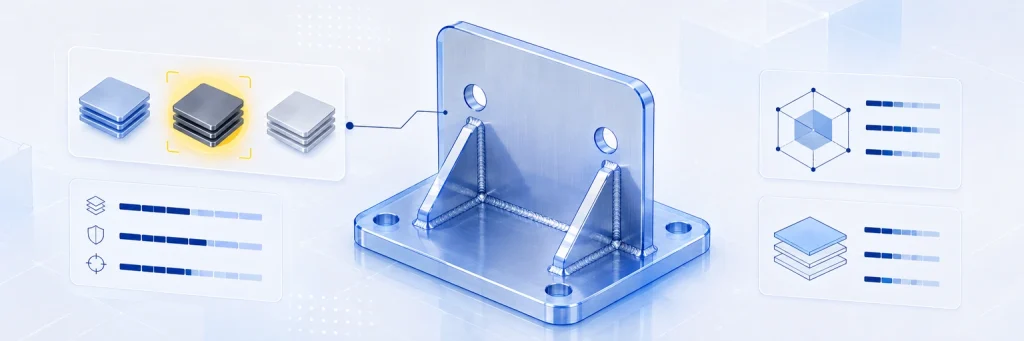
Carbon steel is one of the most widely used materials across industries thanks to its balance of strength, workability, and cost. In this guide we cover what carbon steel is, its properties, and the benefits and drawbacks of its most common grade — SS400.