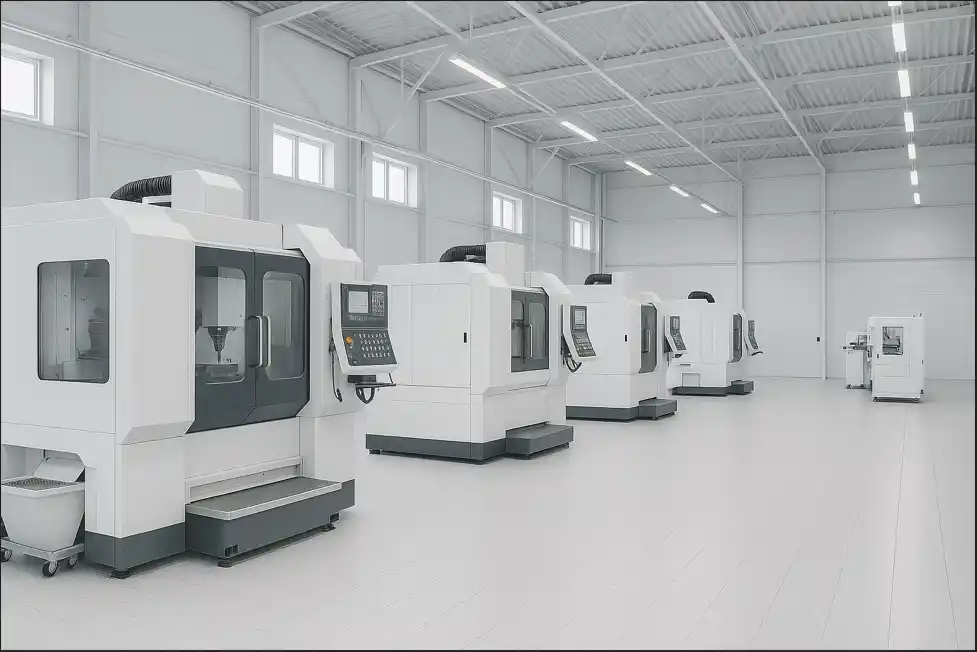
CNC machining services at meviy deliver high-precision custom parts directly from your CAD data. With advanced CNC milling and turning, we ensure tight tolerances, consistent quality, and fast lead times across a wide range of materials, supported by instant online quoting for an efficient path from design to production.
Trusted by leading engineering teams:
These formats are supported by meviy:
Free quote in seconds • No credit card required
CNC milling provides a precise and versatile way to manufacture complex geometries, pockets, and contours from solid material. It is widely used in industrial production to achieve high accuracy, tight tolerances, and repeatable results for both prototypes and series parts.
CNC turning is an efficient process for producing rotationally symmetric parts such as shafts, bushings, and pins. By machining the workpiece with controlled rotation, it delivers excellent dimensional accuracy, smooth surface finishes, and consistent quality at scale.
Log in with your MISUMI account and upload the CAD file of the desired part.
Select additional settings such as the required material, surface treatment or tolerances.
Click on ‘Confirm the quotation conditions’ to receive an instant quote with price and shipping days.
Now select the desired shipping option and click on ‘Add to shopping cart’ to continue with your order.
Join thousands of engineers who trust meviy for their manufacturing needs
Industry-leading capabilities backed by MISUMI quality standards
Fast CNC machining with lead times as short as 24–48 hours. Accelerate prototyping and production cycles while maintaining high dimensional accuracy and consistent quality.
Material certificates, dimensional inspection reports, and compliance documentation available on request. Meet industry standards with full traceability for CNC-machined parts.
Choose from aluminium, steel, stainless steel, and engineering plastics. Multiple grades and material conditions are available to match mechanical, thermal, and functional requirements.
Professional surface treatments such as anodising, powder coating, bead blasting, and machining-specific finishes. Achieve the required surface quality, appearance, and performance.
CNC machining with tight tolerances down to ±0.1 mm, supported by rigorous in-process and final inspections. Advanced metrology ensures parts meet exact specifications.
Reliable shipping with full tracking. Expedited options are available for urgent CNC machining projects, with parts delivered safely packaged and ready for use.
With decades of precision engineering expertise, MISUMI ensures consistent quality and reliability across every order. Trust in proven manufacturing excellence.
Our CNC machining services deliver high-quality custom parts across all options, from material selection to surface treatments. Below, you will find detailed information about our comprehensive capabilities, covering CNC milling and CNC turning, with a wide range of metals and engineering plastics as well as precise surface treatments.
Customise your CNC machined parts with confidence, knowing they are produced to meet the highest standards of accuracy, durability, and repeatability for demanding industrial applications.
EN 1.0038 equiv.
EN 1.0038 equiv. (flat bar)
EN 1.0038 equiv. (annealed)
EN 1.1191 equiv. (flat bar)
EN 1.1206 equiv.
EN 1.1206 equiv. (20–27 HRC)
EN 1.7220 equiv.*
EN 1.2310 equiv.*
EN 1.2379 equiv.*
EN 1.2344 equiv.*
EN 1.3505 equiv.*
EN 1.4305 equiv.
EN 1.4301 equiv.
EN 1.4401 equiv.
EN 1.4016 equiv.
EN 1.4125 equiv.*
EN AW-2017 equiv.
EN AW-5052 equiv.
EN AW-6061 equiv.
EN AW-6063 equiv.
EN AW-7075 equiv.
Polyacetal (standard, white)
Polyacetal (standard, black)
MC Nylon (standard, blue)
MC Nylon (black ash)
MC Nylon (ivory)
ABS (standard, natural colour)
ABS (standard, black)
PC (standard, transparent)
PC (standard, black)
PP (standard, natural colour)
Bakelite (paper, natural colour)
Bakelite (paper, black)
Bakelite (cotton, natural)
Fluorine (PTFE, standard, white)
UHPE
UHPE (conductivity, black)
PEEK (standard, grey-brown)
PPS (standard, natural colour)
Acrylic (standard, transparent)
UMWPE (standard, white)
PVC (standard, grey)
EN CW614N equiv.
* Heat treatment is available.
Black Oxide
Electroless Nickel Plating
Hard Chrome Plating (Flash Plating)
Trivalent Chromate (clear)
Trivalent Chromate (black)
Anodised (clear)
Anodised (black)
Anodised (black, matt)
Anodised (red)
Anodised (gold)
Hard Anodised (clear)
LTBC Surface Treatment
Salt Bath Nitriding
Phosphating (manganese)
CNC machining is a manufacturing process in which computer-controlled machines remove material from a solid workpiece to create precise parts. CNC stands for Computer Numerical Control. The process uses digital CAD data to control cutting tools with high accuracy and repeatability, making it ideal for producing complex and high-precision components.
CNC machining mainly includes CNC milling and CNC turning.
CNC milling uses rotating cutting tools to remove material from a stationary workpiece, while CNC turning rotates the workpiece against a stationary cutting tool. Additional processes such as drilling, threading, and contour machining are often integrated into CNC operations.
A wide range of materials can be processed using CNC machining, including metals such as aluminium, steel, stainless steel, brass, and titanium, as well as engineering plastics. Material selection depends on mechanical requirements, tolerances, surface finish, and the intended application of the part.
CNC machined parts are used wherever high dimensional accuracy, strength, and consistency are required. Typical applications include mechanical components, housings, brackets, shafts, fixtures, and functional prototypes. They are commonly used for both end-use parts and pre-series production.
CNC machining offers very high precision, often achieving tolerances in the range of a few micrometres, depending on the machine, material, and geometry. This makes the process suitable for applications with tight tolerances and demanding functional requirements.
Key advantages include high accuracy, excellent repeatability, and the ability to produce complex geometries. CNC machining is well suited for both prototypes and series production. Automated machining reduces human error and ensures consistent quality across multiple parts.
Yes. CNC machining is limited by tool accessibility, minimum feature sizes, and maximum part dimensions. Very thin walls, deep narrow cavities, or undercuts may be difficult or impossible to machine without special setups. In such cases, design adjustments may be required.
Production time depends on part complexity, material, tolerances, and quantity. Simple parts can often be manufactured within a few days, while complex geometries or larger batch sizes may require longer lead times. Automated quoting systems can provide instant lead time estimates based on CAD data.
Cost is influenced by material type, machining time, part complexity, tolerances, surface finishes, and order quantity. Parts with complex geometries or tight tolerances generally require longer machining times and therefore higher costs. Batch production typically reduces the cost per part.
Parts should be designed with manufacturability in mind. This includes avoiding unnecessary tight tolerances, ensuring sufficient tool access, using standard hole sizes where possible, and maintaining adequate wall thickness. Proper design significantly reduces cost and improves production reliability.