

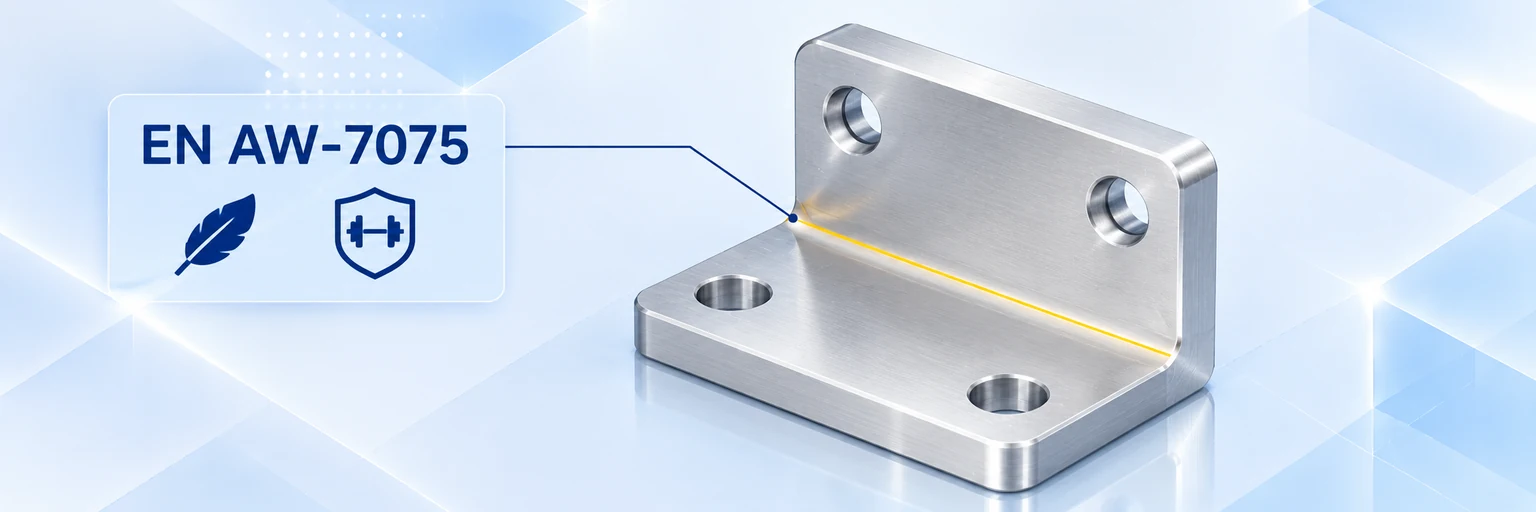
7075 aluminium (EN AW-7075) is one of the strongest aluminium alloys available. Alloyed mainly with zinc, magnesium and copper and heat-treated to the T6 condition, it reaches tensile strengths of over 500 MPa — comparable to many steels at about one third of the weight. That makes it a first choice for aerospace, motorsport and precision tooling, where strength and low weight matter equally.
This guide covers the chemical composition, international equivalents, physical and mechanical properties of EN AW-7075, how to machine, form, join and finish it, and how it compares with 6061, 5052 and 2017.
What is 7075 aluminium?
EN AW-7075 is a wrought aluminium alloy of the 7000 series, in which zinc is the main alloying element. It is heat-treatable: solution annealing, quenching and artificial ageing form fine MgZn₂ precipitates that make the alloy extremely strong. Its chemical designation is EN AW-AlZn5.5MgCu, and it is also known as “super duralumin” or “Zicral”.
7075 offers an outstanding strength-to-weight ratio, high fatigue strength and very good machinability. In return, its corrosion resistance and weldability are lower than those of the 5000 and 6000 series alloys.
Chemical composition of EN AW-7075
Zinc and magnesium form the strengthening precipitates, copper increases strength further, and chromium improves the resistance to stress corrosion cracking (according to EN 573-3):
| Element | Content (%) |
|---|---|
| Zinc (Zn) | 5.1–6.1 |
| Magnesium (Mg) | 2.1–2.9 |
| Copper (Cu) | 1.2–2.0 |
| Chromium (Cr) | 0.18–0.28 |
| Iron (Fe) | Max. 0.50 |
| Silicon (Si) | Max. 0.40 |
| Manganese (Mn) | Max. 0.30 |
| Titanium (Ti) | Max. 0.20 |
| Aluminium (Al) | Balance |
7075 aluminium equivalents
7075 is standardised worldwide under different designations. The chemical composition is equivalent; permitted ranges may differ slightly between standards:
| Standard | Designation |
|---|---|
| EN (Europe) | EN AW-7075, EN AW-AlZn5.5MgCu |
| Material number (DIN) | 3.4365 (AlZnMgCu1.5) |
| AA / ASTM (USA) | 7075 |
| UNS | A97075 |
| JIS (Japan) | A7075 |
| GB (China) | 7075 |
Physical properties of EN AW-7075
| Property | Value |
|---|---|
| Density | Approx. 2.81 g/cm³ |
| Melting range | Approx. 477–635 °C |
| Thermal conductivity (T6) | Approx. 130 W/m·K |
| Electrical conductivity (T6) | Approx. 33% IACS (approx. 19–20 MS/m) |
| Coefficient of thermal expansion | Approx. 23.6 × 10⁻⁶ /K (20–100 °C) |
| Young's modulus | Approx. 71–72 GPa |
| Shear modulus | Approx. 26–27 GPa |
| Poisson's ratio | Approx. 0.33 |
Mechanical properties: T6, T651 and T73
The mechanical properties of 7075 depend on the temper:
- T6: solution heat-treated and artificially aged to maximum strength.
- T651: T6 plus stress relief by controlled stretching. Plates in T651 distort less during machining and are the standard for precision parts.
- T73: over-aged for much better resistance to stress corrosion cracking, at around 10–15% lower strength.
| Property (typical values) | T6 / T651 | T73 |
|---|---|---|
| Tensile strength | Approx. 510–580 MPa | Approx. 470–510 MPa |
| Yield strength (Rp0.2) | Approx. 430–500 MPa | Approx. 390–440 MPa |
| Elongation at break | Approx. 5–12% | Approx. 9–13% |
| Brinell hardness | Approx. 150–160 HBW | Approx. 130–140 HBW |
Minimum values depend on the product form and thickness and are defined in the relevant product standards, for example EN 485-2 for plates.
Advantages and disadvantages of 7075 aluminium
- Outstanding strength-to-weight ratio — the highest among common aluminium alloys.
- High fatigue strength.
- Very good machinability in the T6 and T651 tempers.
- Good dimensional stability of stress-relieved T651 plates.
- Suitable for anodising and hard anodising.
The drawbacks:
- Only moderate corrosion resistance; susceptible to stress corrosion cracking in the T6 temper.
- Poor weldability with conventional fusion welding.
- Low formability in the T6 temper.
- Higher price than 5000 and 6000 series alloys.
Machining, forming, joining and finishing 7075
Machinability
7075 machines very well in the T6 and T651 tempers. Its high hardness produces short, well-breaking chips, clean edges and very good surface finishes — better than softer alloys such as 5052, which tend to smear. Sharp carbide tools, high cutting speeds and good chip evacuation give the best results. For parts with a lot of material removal, use stress-relieved T651 plates to keep distortion low.
Formability
In the T6 temper, 7075 can only be bent with large radii. Complex shapes are formed in the annealed (O) or freshly quenched (W) temper, or by warm forming, and then heat-treated to the final temper.
Welding and joining
Fusion welding such as TIG or MIG is not recommended: 7075 is prone to hot cracking, and the heat-affected zone loses much of its strength. Friction stir welding (FSW) can join 7075 with good results. In practice, 7075 parts are usually joined mechanically with screws, bolts or rivets, or bonded with structural adhesives.
Forging
7075 is very well suited to forging, typically at approx. 370–430 °C. Forged parts have a refined grain structure with high strength, fatigue resistance and toughness.
Surface treatment
7075 is readily anodised for better corrosion and wear resistance. Because of its high zinc and copper content, clear anodised layers can show a slightly yellowish or grey tint. Hard anodising creates very wear-resistant surfaces, and paint or powder coating provides extra protection outdoors. Learn more in our guide to metal finishing.
Applications of 7075 aluminium
- Aerospace structures such as frames, ribs and wing components.
- Motorsport and high-performance automotive parts.
- Bicycle components, climbing equipment and sporting goods.
- Moulds for prototypes and small series in injection moulding.
- Jigs, fixtures and machine components with high loads.
- Defence equipment and robotics.
7075 vs 6061 vs 5052 vs 2017
7075 is the strongest of the common aluminium alloys, but not always the best choice. This comparison uses meviy reference values for CNC-machined materials:
| Property | EN AW-7075 | EN AW-6061 | EN AW-5052 | EN AW-2017 |
|---|---|---|---|---|
| Alloy type | Al-Zn-Mg-Cu, heat-treatable | Al-Mg-Si, heat-treatable | Al-Mg, non-heat-treatable | Al-Cu, heat-treatable |
| Tensile strength | 510–580 MPa | 260–310 MPa | 210–265 MPa | 390–500 MPa |
| Yield strength | 430–500 MPa | 240–270 MPa | 125–190 MPa | 250–350 MPa |
| Density | 2.80 g/cm³ | 2.70 g/cm³ | 2.68 g/cm³ | 2.79 g/cm³ |
| Corrosion resistance | Moderate | Good | Excellent | Low |
| Weldability | Poor | Good | Excellent | Poor |
| Machinability | Very good | Good | Fair (smears) | Very good |
| Price | High | Medium | Low | Medium to high |
| Typical applications | Aerospace, motorsport, moulds, high-load parts | Structural parts, frames, general engineering | Sheet metal parts, enclosures, tanks, marine | Machined parts, fasteners, rivets |
- Choose 7075 when maximum strength at low weight is essential and the part is joined mechanically.
- Choose 6061 as the versatile all-rounder with good strength, corrosion resistance and weldability.
- Choose 5052 for corrosion-resistant, formable and weldable parts, especially sheet metal.
- Choose 2017 for strong, easily machined parts in dry environments, where corrosion is not an issue.
Machined 7075 aluminium parts with meviy
meviy, the on-demand manufacturing platform by MISUMI, produces individually designed parts directly from your 3D CAD data — not catalogue or standard parts. EN AW-7075 equiv. (A7075, T6/T651) is available for CNC milling and CNC turning, alongside EN AW-6061, 5052 and 2017 equivalents.
- Finishes for 7075 include anodising (clear, black and coloured), hard anodising, electroless nickel plating and chromate passivation — availability depends on the delivery option.
- Tolerances, threads and fits are set directly in the 3D viewer — no 2D drawing required.
- Instant price and lead time, so you can compare 7075 with 6061 or 2017 in seconds.
For other non-ferrous materials, see our guide to copper alloys. Learn more about CNC machining with meviy.
Frequently asked questions about 7075 aluminium
What is 7075 aluminium used for?
7075 aluminium is used where high strength and low weight are both critical: aerospace structures, motorsport parts, bicycle and sports equipment, moulds, jigs, fixtures and high-load machine components.
Is 7075 stronger than 6061?
Yes. 7075-T6 reaches a tensile strength of around 510–580 MPa, roughly twice that of 6061-T6 at about 260–310 MPa. 6061, however, offers better corrosion resistance and weldability at a lower price.
Can 7075 aluminium be welded?
Conventional fusion welding (TIG, MIG) is not recommended because 7075 is prone to hot cracking and loses strength in the heat-affected zone. Friction stir welding works well; otherwise, use screws, rivets or structural adhesives.
What is the difference between 7075-T6 and 7075-T651?
Both have the same strength. T651 is additionally stress-relieved by controlled stretching, so plates distort much less during machining. For precision CNC parts, T651 is the preferred temper.
What is the equivalent of EN AW-7075?
EN AW-7075 corresponds to material number 3.4365 (AlZnMgCu1.5), AA 7075 in the USA, UNS A97075, JIS A7075 in Japan and 7075 in China (GB).
Conclusion
7075 aluminium (EN AW-7075) is one of the strongest aluminium alloys, with a tensile strength of over 500 MPa in the T6 temper and very good machinability. It is the material of choice for lightweight, highly loaded parts in aerospace, motorsport and tooling. Its trade-offs — moderate corrosion resistance, poor weldability and a higher price — mean that 6061, 5052 or 2017 are often the better choice when maximum strength is not required.