


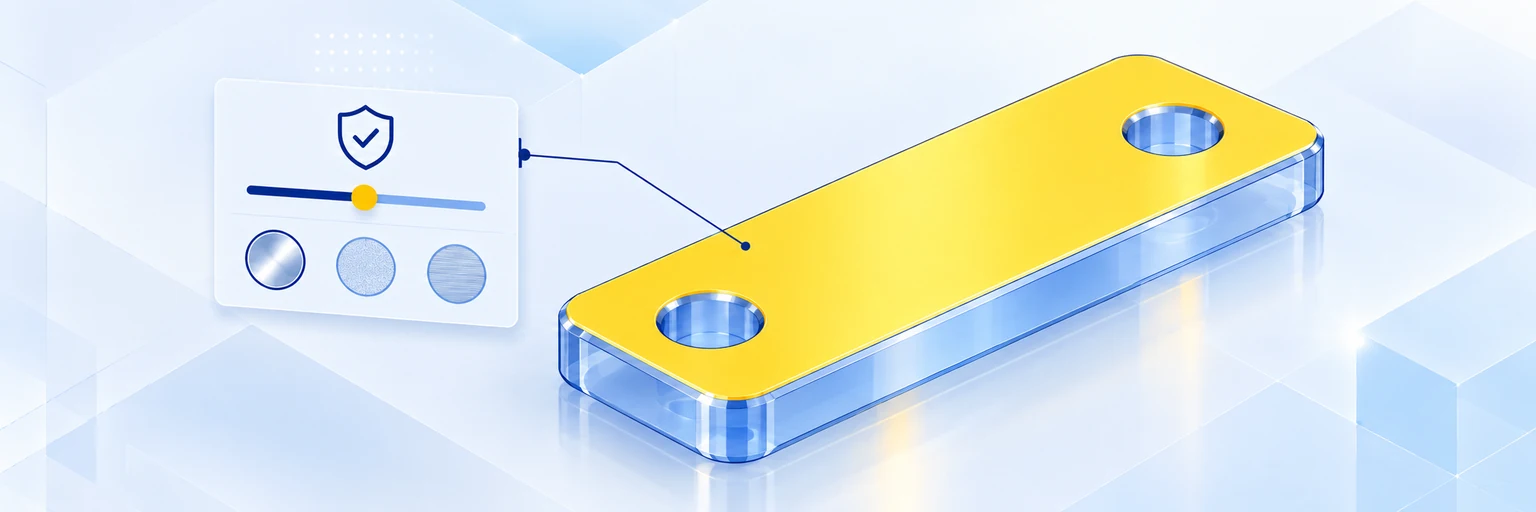
Metal finishing protects parts against corrosion, makes them harder and more wear-resistant, and gives them the colour or appearance they need. Plating, anodising, powder coating and wet paint all achieve this in different ways — and the right choice depends on the base material, the function of the part and its tolerances.
This guide explains how the most important metal finishing processes work, compares them side by side, and shows how to choose and design for the right finish.
Why metal parts are finished
Finishing a metal part serves three main purposes:
- Corrosion protection: materials such as steel rust easily. A zinc, nickel or paint layer protects the surface from oxidation.
- Function: finishes can increase hardness and wear resistance, improve sliding properties or solderability, make a surface electrically conductive — or electrically insulating.
- Appearance and colour coding: a glossy, matte or coloured surface improves the look of a product and can mark safety-relevant areas at a glance.
Types of metal finishes at a glance
| Finish | Principle | Base materials | Typical thickness | Main benefit |
|---|---|---|---|---|
| Electroplating (e.g. zinc, chrome) | Metal deposited with electric current | Conductive metals | Approx. 5–25 µm | Corrosion protection, appearance, wear resistance |
| Electroless nickel plating | Nickel-phosphorus alloy deposited chemically, without current | Steel, stainless steel, aluminium, copper alloys | Approx. 5–25 µm | Very uniform layer, wear and corrosion resistance |
| Anodising | Electrochemical growth of an oxide layer | Aluminium | Approx. 5–25 µm | Corrosion protection, colours, electrical insulation |
| Hard anodising | Thicker, denser oxide layer at low temperature | Aluminium | Approx. 25–150 µm | Very high wear resistance |
| Powder coating | Electrostatically applied powder, cured in an oven | Steel, aluminium | Approx. 50–110 µm | Robust, colourful finish |
| Wet paint | Liquid paint, sprayed and dried | Almost any material | Approx. 15–45 µm | Thin, flexible colour finish |
| Black oxide | Chemical conversion layer | Steel | Negligible | Black appearance with no dimensional change |
Plating
Plating covers the surface of a part with a thin layer of another metal. It can enhance appearance, improve corrosion resistance and add functional properties — for example, nickel or copper-tin plating improves solderability, while other platings improve sliding properties or electrical conductivity. A key economic advantage: you get the surface properties of an expensive metal without making the whole part from it. Plating methods are divided into two groups.
Dry plating
Dry plating, also known as vacuum deposition, deposits a metal or compound film onto the surface in a vacuum. Examples are physical vapour deposition (PVD) and chemical vapour deposition (CVD). Dry plating is widely used in semiconductor manufacturing and for hard tool coatings. It usually involves elevated temperatures and is more expensive than wet plating.
Wet plating
In wet plating, the part is immersed in a solution containing metal ions. Most of what is commonly called plating is wet plating, and it includes two main methods: electroless plating, explained in the next section, and electroplating.
In electroplating, the part to be plated is connected as the negative electrode (cathode) and the coating metal as the positive electrode (anode). When a direct current flows, metal ions are reduced and deposited on the surface of the part. The coating thickness depends on the current density: on complex shapes, edges and protruding areas receive thicker layers, while recesses and bores receive thinner ones. Because the thickness can be controlled by current and time, the right coating thickness has to be defined for each application.
Common types of electroplating include:
- Zinc plating: one of the most widely used methods of corrosion protection for steel. Zinc protects the steel sacrificially — it corrodes in place of the iron. A trivalent chromate passivation is usually applied on top for additional protection. Zinc-plated steel sheet is explained in our article on SECC vs. SGCC.
- Chrome plating: decorative chrome gives metal surfaces a high-gloss finish, while hard chrome plating is used on machine parts and tools for its excellent wear and corrosion resistance.
- Gold plating: combines a lustrous appearance with corrosion resistance and electrical conductivity, for example on electrical contacts.
- Silver plating: offers very high electrical conductivity and is used on connectors; because silver tarnishes, an additional protective treatment is often applied.
- Plastic plating: gives plastic parts a metallic appearance and surface properties while keeping their low weight. It accounts for a large share of decorative plating.
Other specialised platings include rhodium, palladium and platinum. A related method is hot-dip galvanising, in which steel parts are immersed in molten zinc; it is used for structural steel, wire and outdoor components.
Electroless nickel plating
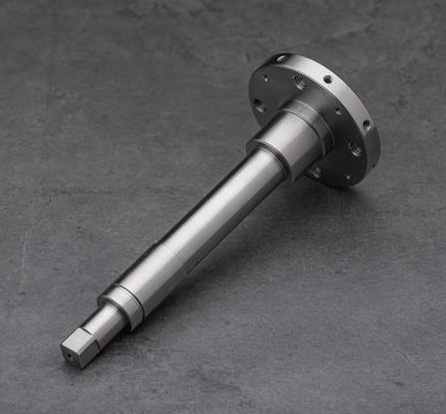
Electroless nickel plating deposits a nickel-phosphorus alloy chemically, without any external current. Because no current density is involved, the layer grows evenly on every surface the solution reaches — including threads, bores and deep recesses. This makes it one of the most popular finishes for precision CNC parts.
How electroless nickel plating works
- Surface preparation: the part is cleaned thoroughly to remove oil, dirt and oxide layers. Weld spatter is removed and sharp edges are rounded so that the layer adheres evenly.
- Activation: an acid or catalyst solution activates the surface so that nickel can be deposited.
- Plating: the part is immersed in a heated bath — typically at 85–95 °C — containing nickel salts and a reducing agent, usually sodium hypophosphite. An autocatalytic reaction deposits the nickel alloy evenly over the entire surface. The pH value, for example 4.5–5.5 for nickel-phosphorus baths, is controlled precisely.
- Post-treatment: a heat treatment can increase the hardness of the layer considerably. High-strength steels must be baked after plating to prevent hydrogen embrittlement.
Typical layer thicknesses are 5–25 µm. The phosphorus content determines the properties: low-phosphorus layers are harder, while high-phosphorus layers offer the best corrosion resistance. Note that heat treatment at too high a temperature can reduce the corrosion resistance of high-phosphorus layers.
Benefits of electroless nickel plating
- Uniform coating, even on threads, bores and complex geometries
- Excellent corrosion resistance, also against many chemicals
- High wear resistance and surface hardness
- Good sliding properties and solderability
- Suitable for steel, stainless steel, aluminium, copper alloys and — after special pretreatment — some plastics
- Minimal build-up, so tight tolerances are maintained
Typical applications include critical aerospace components, gears, shafts and fuel system parts in vehicles, components for oil and gas, solderable and EMC-shielding surfaces in electronics, and precision CNC parts such as gears, housings and moulds.
Electroless vs. electrolytic nickel plating
| Property | Electroless nickel | Electrolytic nickel |
|---|---|---|
| Deposition | Chemical (autocatalytic) | Electrochemical |
| Current required | No | Yes |
| Layer | Nickel-phosphorus alloy | Pure nickel |
| Uniformity | Excellent, even in bores | Thicker on edges, thinner in recesses |
| Base materials | Conductive and, after activation, non-conductive | Conductive only |
| Cost | Higher | Lower, especially in large quantities |
Anodising and hard anodising
Anodising is an electrochemical process that thickens the natural oxide layer on aluminium. The parts are immersed in an acid electrolyte and connected as the anode; the current grows a hard aluminium oxide layer from the surface. This layer improves corrosion and wear resistance and insulates electrically. Because it is porous, it can be dyed in many colours before it is sealed.
Unlike plating, the anodic layer is not simply added on top: it grows roughly half into the material and half outward. There are three main types:
| Property | Chromic acid anodising | Sulphuric acid anodising | Hard anodising |
|---|---|---|---|
| Electrolyte | Chromic acid | Sulphuric acid | Sulphuric acid at higher voltage and low temperature |
| Layer thickness | Approx. 1–10 µm | Approx. 5–25 µm | Approx. 25–150 µm |
| Wear resistance | Moderate | Good | Very high |
| Corrosion resistance | Good | Good to very good | Very good |
| Colours | Grey, rarely dyed | Wide range of dyed colours | Natural grey to bronze; limited dyeing |
| Typical uses | Aerospace, fatigue-critical parts | Decorative and general technical parts | Sliding, wear-loaded and high-performance parts |
| Environment | Contains hexavalent chromium; heavily restricted under REACH | Standard process | Standard process, more energy-intensive |
Hard anodising
Hard anodising, also called hardcoat anodising, uses a higher voltage and a lower bath temperature than standard anodising. The result is a much thicker, denser oxide layer that is extremely hard and wear-resistant, offers very good corrosion protection and insulates electrically. Hard anodised aluminium is used for sliding and wear parts in machine building, the automotive industry, aerospace and defence, as well as for high-end cookware and precision tools.
Keep these limitations in mind:
- Dimensional change: the thick layer changes the dimensions and must be considered in the design for tight tolerances.
- Limited colours: the dense layer absorbs dyes less readily than standard anodising.
- Alloy suitability: high-silicon casting alloys and some copper-rich alloys give inconsistent results.
- Brittleness: the hard layer can crack under high impact or deformation.
- Cost: the more demanding process makes hard anodising more expensive than standard anodising.
Powder coating vs. wet paint
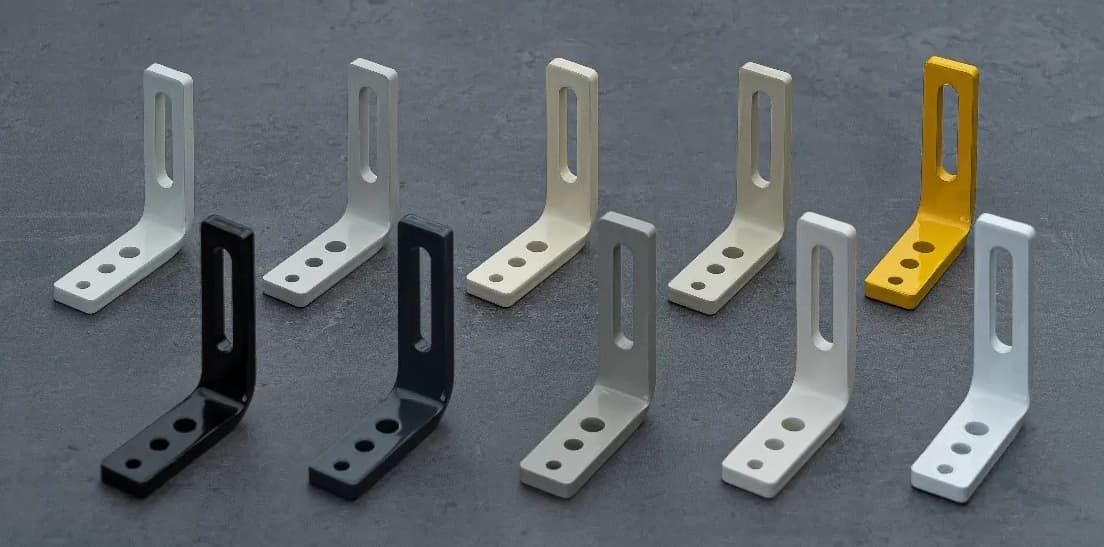
In powder coating, a dry powder of pigment and binder particles is charged electrostatically and sprayed onto the part, where it adheres evenly. The part is then baked in an oven at typically around 160–200 °C: the powder melts and fuses into a continuous, tightly adhering film. The result is a thick, tough coating that resists abrasion, impact, scratches, moisture and chemicals — ideal for parts in outdoor, humid or harsh environments. Powder coating is also available in many colours and textures.
Wet paint is applied as a liquid and dries to a much thinner film. It suits materials and parts that cannot be powder coated, offers a wide range of shades and gloss levels, and is often the more economical option for thin layers and indoor use.
| Property | Powder coating | Wet paint |
|---|---|---|
| Application | Dry powder, electrostatic, oven-cured | Liquid, sprayed and dried |
| Layer thickness | Thick (approx. 50–110 µm) | Thin (approx. 15–45 µm) |
| Resistance | Very high against impact, abrasion and chemicals | Good |
| Dimensional impact | Higher — consider for fits and threads | Lower |
| Typical uses | Housings, frames, outdoor and heavy-duty parts | Thin-walled parts, signal colours, indoor parts |
Colour-coded finishes for safety
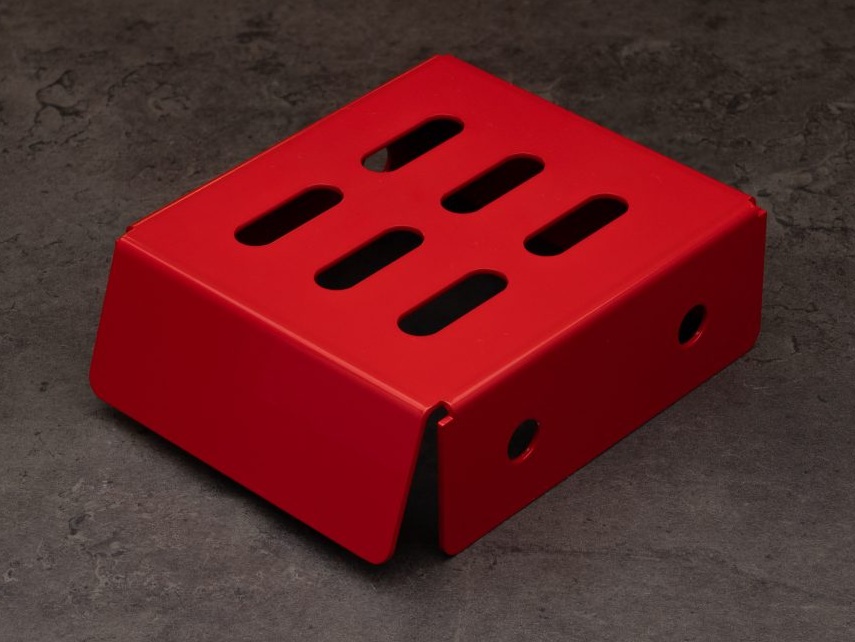
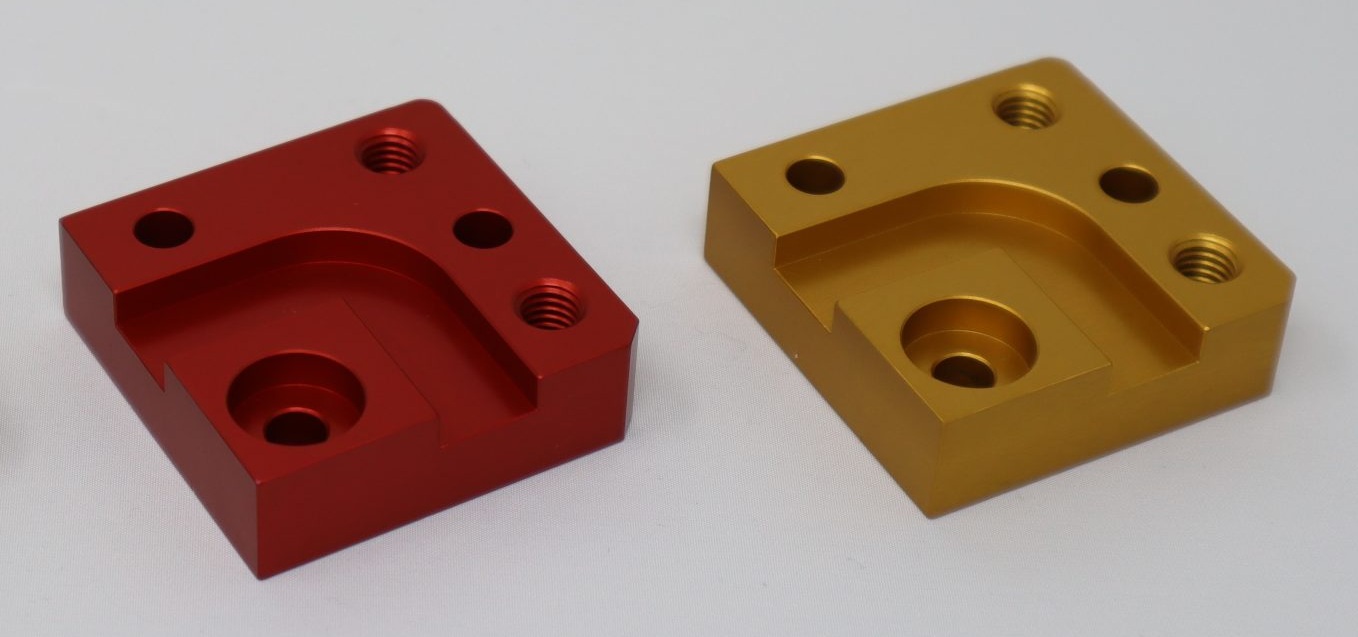
Colour is more than decoration. Red in particular is universally recognised as a warning signal — it is the colour of stop signs, fire extinguishers and emergency buttons. Red parts stand out against almost any background, so they help designate hazard areas, stopping points or restricted zones and make workflows clearer for operators.
- Red anodising for aluminium parts: ideal for safety barriers, emergency stop panels or machine edges that must not be touched — with the corrosion and scratch resistance of anodising.
- Red wet paint for sheet metal: suitable for steel and other materials that cannot be anodised — for example to mark access points on enclosures or restricted zones on the production floor.
For parts used outdoors, keep in mind that dyed anodising — red in particular — can fade under UV light. For long-term outdoor signal colours, paint or powder coating with UV-stable pigments is usually the better choice. Combined with other colours, red components can form a coherent system of visual guidance.
Other finishes
- Black oxide: a thin black conversion layer on steel with practically no dimensional change — ideal for parts with tight tolerances and indoor use.
- Phosphate coating: improves paint adhesion and running-in behaviour, with moderate corrosion protection.
- Chromate passivation: trivalent chromate layers protect zinc-plated steel and aluminium; on aluminium, they keep the surface electrically conductive.
- Passivation: strengthens the natural passive layer of stainless steel and improves its corrosion resistance.
- Nitriding: a thermochemical surface hardening process for steel with minimal distortion — see our guide to the heat treatment of steel.
How to choose the right finish
| Requirement | Steel | Aluminium |
|---|---|---|
| Corrosion protection | Zinc plating with chromate, electroless nickel, powder coating | Anodising, chromate passivation |
| Wear resistance and hardness | Hard chrome, electroless nickel, nitriding | Hard anodising, electroless nickel |
| Electrical conductivity | Electroless nickel, zinc plating | Chromate passivation, electroless nickel |
| Electrical insulation | Powder coating | Anodising, hard anodising |
| Colour and appearance | Powder coating, wet paint, black oxide | Dyed anodising (e.g. black, red, gold) |
| Tight tolerances | Black oxide, electroless nickel | Standard anodising, electroless nickel |
Design tips for finished parts
- Allow for the layer: every finish except black oxide changes dimensions. Include the layer thickness in fits, bores and threads — anodic layers grow about half inward and half outward.
- Protect functional surfaces: specify which threads or fits must stay free of coating, or plan for rework.
- Plan hanging holes: parts are hung in the bath for many wet processes. At meviy, parts with trivalent chromate, hard chrome plating, anodising or passivation need a through hole of at least ø3.5 mm (or a slot or closed pocket at least 3.5 mm wide, or a tapped through-hole of M5 or larger).
- Round sharp edges: coatings build up on edges in electroplating and can chip on sharp edges.
- Choose a suitable alloy: not every aluminium alloy anodises equally well, especially for hard anodising.
- Consider hydrogen embrittlement: high-strength steels need baking after plating.
Finishes available at meviy
meviy manufactures individually designed custom parts from your own 3D CAD data — not standard or catalogue parts. You select the finish directly when you configure your part and see the price and lead time instantly:
| Service | Available finishes |
|---|---|
| CNC milling | Electroless nickel plating, black oxide, trivalent chromate (clear, black), hard chrome plating (flash), low temperature black chrome, phosphate coating, nitriding, anodising (clear, white matte, black, black matte, red, gold), hard anodising (clear, white matte), passivation, trivalent chromate passivation |
| CNC turning | Electroless nickel plating, black oxide, trivalent chromate (clear, black), hard chrome plating (flash), low temperature black chrome, phosphate coating, salt bath nitriding, anodising (clear, black, black matte), hard anodising (clear), passivation |
| Sheet metal fabrication | Powder coating (15 colours), painting, electroless nickel plating, black oxide, trivalent chromate (clear, black), electrolytic zinc plating, galvanised, anodising (clear, black, matt black), trivalent chromate passivation, hairline finish |
Powder coating and paint colours follow JPMA colour values, with RAL reference values for each colour. Whether you need a red safety component or a wear-resistant hard anodised slide, CNC machining and sheet metal parts from meviy arrive ready to install.
Frequently asked questions about metal finishing
What is the difference between anodising and plating?
Plating deposits a layer of another metal on the surface. Anodising converts the surface of aluminium itself into a hard oxide layer that grows partly into the material. Anodising is only possible on aluminium and similar metals, while plating works on many metals.
What is the difference between electroless and electrolytic nickel plating?
Electroless nickel is deposited chemically without current and forms a very uniform nickel-phosphorus layer, even in bores and recesses. Electrolytic nickel uses an electric current, deposits pure nickel and builds up more on edges than in recesses, but it is usually cheaper for large quantities.
Is powder coating better than wet paint?
Powder coating forms a thicker, more robust layer and is ideal for heavy-duty and outdoor parts. Wet paint is thinner, suits more materials and is often more economical for thin-walled or indoor parts. The better choice depends on the load, the environment and the tolerances.
Does anodising change the dimensions of a part?
Yes. The oxide layer grows about half into the material and half outward. With standard anodising, the change is small; with hard anodising, it must be considered in the design of fits and threads.
Can steel be anodised?
No. Anodising is used for aluminium. For steel, common alternatives are zinc plating, electroless nickel plating, black oxide, powder coating or paint.
Choosing the right finish for your part
Plating, electroless nickel, anodising, powder coating and paint each solve different problems: corrosion protection, wear resistance, conductivity, insulation or colour. Define the requirements of your part early in the design phase, consider the layer thickness in your tolerances, and choose the finish that suits the base material — then your parts will perform reliably for a long time.