


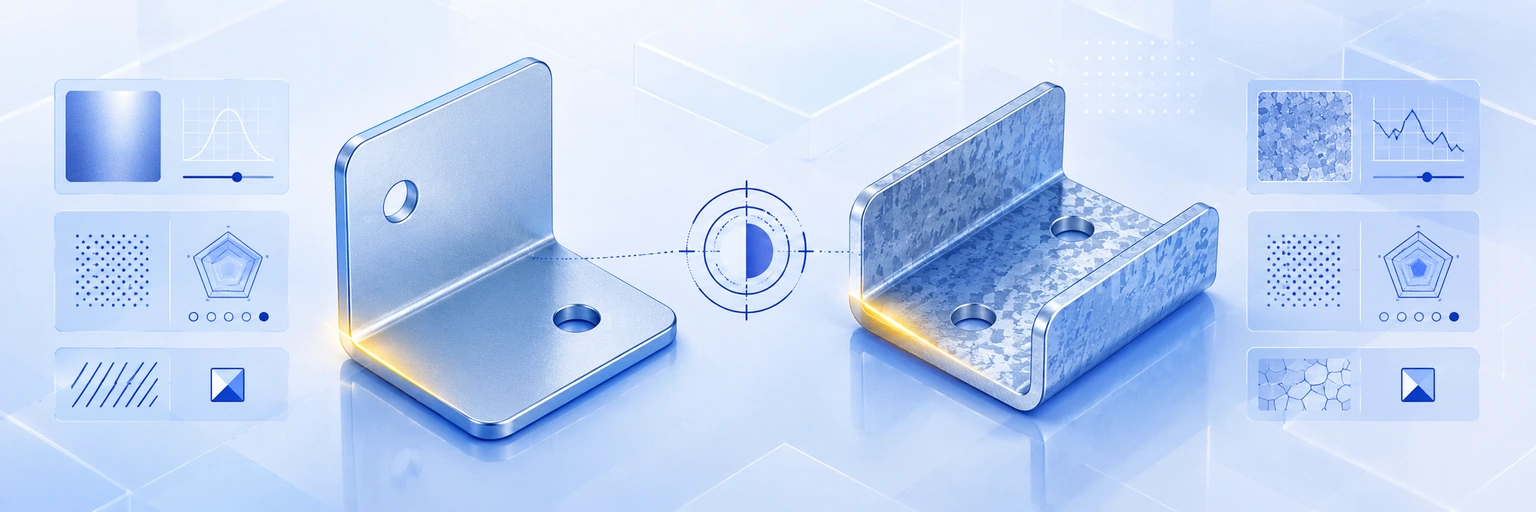
Choosing the right zinc-plated steel can make the difference between a part that lasts and one that fails prematurely. SECC and SGCC are both based on cold-rolled SPCC steel — but their plating methods, coating thickness, and corrosion resistance differ significantly, which directly affects where and how you should use them.
SECC (Electro-Galvanised Steel) uses electrolytic zinc plating to produce a thin, uniform coating with an attractive finish — ideal for indoor applications such as appliance housings and electrical enclosures. SGCC (Hot-Dip Galvanised Steel) is immersed in molten zinc, resulting in a thicker coating with superior long-term corrosion resistance — suited for outdoor and structural use.
In this guide, we break down the plating processes, compare the key properties side by side, and help you decide which material fits your next project. meviy offers both SECC and SGCC as sheet metal materials with lead times as short as one day.
How zinc plating works: hot-dip vs electrolytic
Zinc-plated steel sheets start as SPCC — an affordable, highly workable cold-rolled steel that is prone to rust without surface treatment. Zinc plating protects the base metal through a barrier effect and, in some cases, sacrificial corrosion. The two main methods are hot-dip galvanisation and electro-galvanisation, and each produces a coating with distinct characteristics.
Hot-dip galvanisation (SGCC) — EN 1.0330 equiv.
In this process, steel sheets are immersed in a bath of molten zinc after heating. The result is a relatively thick plating layer that forms an alloy bond between the zinc and the base metal, providing excellent durability and long-term corrosion resistance. Because the process involves high temperatures, it can cause minor heat-induced distortion in some parts.
Electro-galvanisation (SECC) — EN 1.0330 equiv.
Here, zinc is dissolved in a solution and deposited onto the steel surface using an electric current. Methods include zinc ammonium baths and zinc chloride potassium baths with alkaline solutions. The resulting coating is uniform in thickness and offers a decorative surface finish. Unlike hot-dip galvanisation, electro-galvanised steel typically requires a post-treatment step — chromate treatment — to enhance corrosion resistance and prevent white powdery corrosion.
Traditionally, hexavalent chromium was used for chromate treatment, but due to its toxicity, trivalent chromium is now the standard. Many manufacturers are shifting further toward chromium-free alternatives using nickel alloys or molybdenum. Environmental regulations continue to evolve in this area, so it is worth staying informed about the latest requirements.
Pure zinc plating vs zinc alloy plating
Within zinc plating, there is a further distinction based on composition. Pure zinc plating uses only zinc, while zinc alloy plating adds other metals to enhance specific properties. In hot-dip galvanisation, aluminium and magnesium are increasingly added (replacing the older practice of using lead). In electro-galvanisation, nickel and iron are the most common alloying metals.
SECC: characteristics and applications
SECC stands for "Steel Electrolytic Cold Commercial." It is also historically known as "Bonded Steel Sheet," a name dating back to when Nippon Steel first introduced the product. The "CC" suffix indicates that the base material — SPCC — has been cold-rolled, making it a general-purpose steel.
Because it is based on SPCC, SECC retains excellent workability. The electrolytic coating gives it a shiny, attractive surface with good paint adhesion, allowing it to be finished in a wide range of colours. Among processed steel sheets, SECC is the most widely distributed.
SECC typically employs a chromium-free coating for its zinc plating rather than traditional chromate treatment. For other electro-galvanised materials that do require chromate treatment, pre-treated options are readily available, so buyers rarely need to arrange separate treatments.
As a general-purpose material, SECC does not offer very high strength, and its thinner zinc coating makes it unsuitable for harsh outdoor conditions. It is most commonly used for indoor applications such as household appliance casings, electrical enclosure panels, and indoor equipment housings.
SGCC: characteristics and applications
SGCC stands for "Steel Galvanised Cold Commercial." Hot-dip galvanisation is applied to SPCC, so the base properties remain similar — good workability and affordability. The key difference is the thicker galvanised coating, which provides significantly better corrosion resistance than SECC.
SGCC belongs to a broader family that includes alloyed hot-dip galvanised sheets and galvalume steel sheets. Despite not offering exceptionally high strength, its outstanding corrosion resistance makes it suitable for demanding environments. Typical applications include transmission towers, power-line guardrails, automotive chassis components, shutters, awnings, and corrugated steel sheets for building exteriors and roofing.
One characteristic to be aware of is spangle formation — geometric patterns that can appear on the surface due to zinc crystallisation. Spangle does not affect the material's mechanical properties, but it may be relevant for visible surfaces. Another consideration is zinc transfer during press forming: a thin layer of zinc can shear off and adhere to the mould, increasing friction and potentially causing forming defects.
SECC vs SGCC at a glance
The table below summarises the key differences to help you choose the right material for your application.
| Property | SECC (electro-galvanised) | SGCC (hot-dip galvanised) |
|---|---|---|
| Plating method | Electrolytic zinc deposition | Immersion in molten zinc |
| Coating thickness | Thin, uniform | Thick, alloy-bonded |
| Corrosion resistance | Good (indoor use) | Very good (outdoor use) |
| Workability | Very good | Good |
| Surface finish | Shiny, smooth, excellent paint adhesion | Rougher surface, may show spangle patterns |
| Chromate treatment | Chromium-free coating (no chromate needed) | Not required |
| Heat distortion risk | Low | Possible |
| Typical applications | Appliance casings, indoor electrical enclosures, equipment housings | Transmission towers, guardrails, automotive chassis, roofing, shutters |
In short: choose SECC when you need a workable, cost-effective material with a clean finish for indoor parts. Choose SGCC when long-term corrosion resistance and outdoor durability are the priority.