

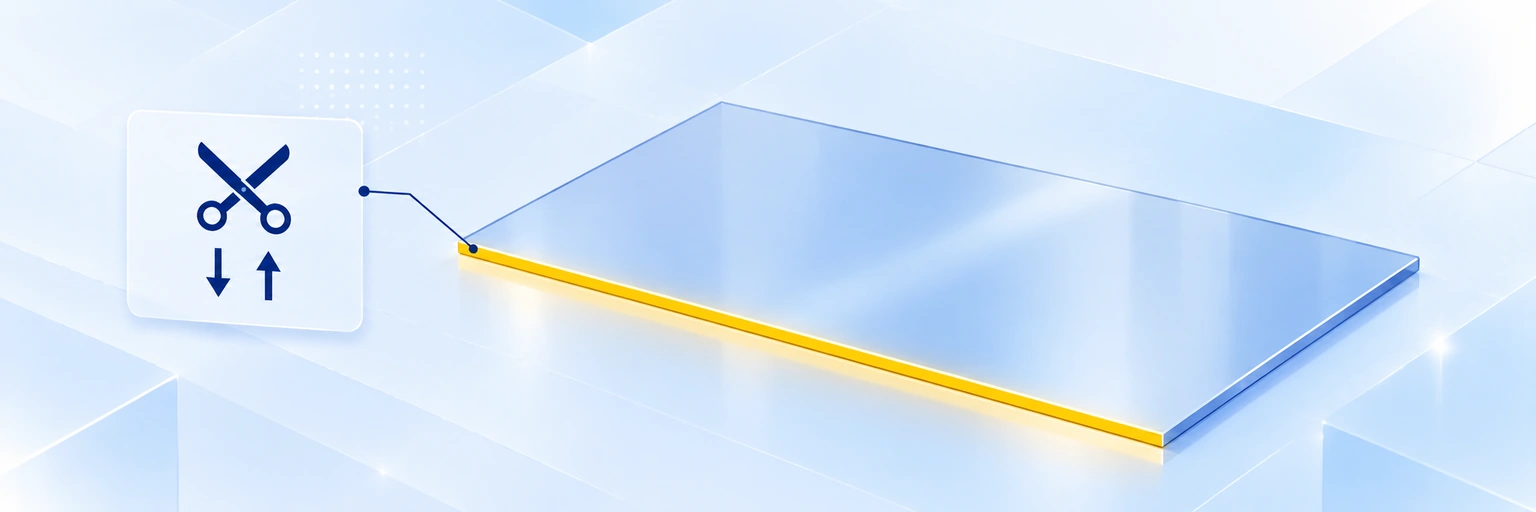
Sheet metal shearing — also called shear cutting — is a cold cutting process that separates sheet metal along a straight line between two blades, without heat, chips or kerf. It is the fastest and most economical way to cut coils and large sheets into strips and blanks before further processing.
This guide explains how shear cutting works, which shearing machines are used, what the cut edge looks like, and how shearing compares with laser cutting and punching.
What is sheet metal shearing?
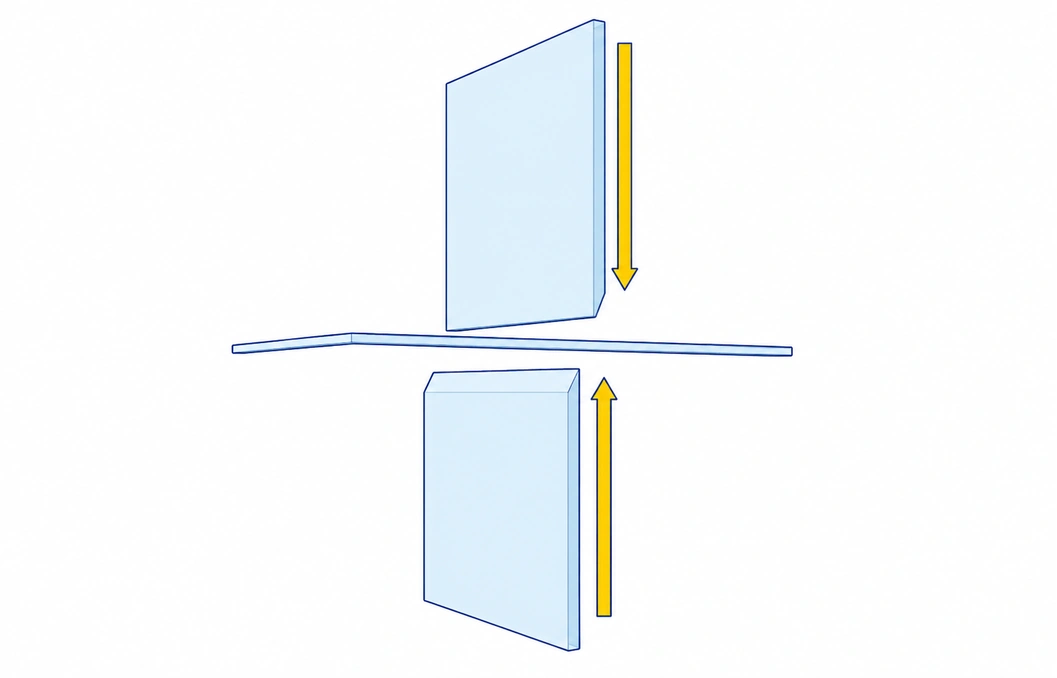
Sheet metal shearing is a mechanical cutting process in which an upper and a lower blade move past each other and apply opposing shear forces to the material. The sheet first deforms plastically, then cracks start at both cutting edges and the material fractures along the cutting line. Scissors work on exactly the same principle.
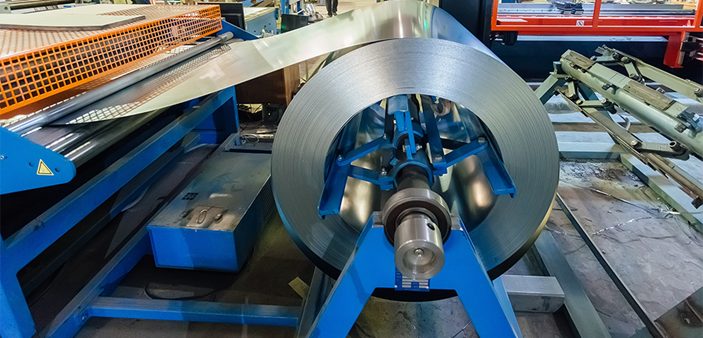
Shearing is used for steel, stainless steel, aluminium, copper and brass sheets, as well as for plastic sheets and paper. Unlike laser cutting, which produces complex contours, shearing only makes straight cuts. It is therefore mainly used at the start of the sheet metal fabrication process, to cut coils and standard sheets into blanks of the required size. Punching and blanking are also shearing processes — the only difference is that the cutting edges are closed contours instead of straight blades.
How shear cutting works
A shearing machine — also called a guillotine shear, power shear or squaring shear — cuts the sheet in three steps:
- Positioning and clamping: the sheet is placed against the back gauge, and hold-down clamps press it firmly onto the machine table so it cannot move or tilt.
- Cutting: the upper blade moves down past the fixed lower blade. The material deforms plastically, then fractures along the cutting line.
- Separation: the cut-off strip or blank falls away from the machine, and the upper blade returns to its starting position.
Two settings determine the cut quality:
- Rake angle (shear angle): the upper blade is inclined, typically by about 0.5° to 3°, so it cuts progressively along the sheet instead of all at once. This reduces the required force. Thicker sheets need a larger rake angle — but too large an angle causes the cut strip to bow or twist.
- Blade clearance: the gap between upper and lower blade, typically about 5–10% of the sheet thickness depending on the material. Too little clearance increases force and blade wear; too much clearance causes large burrs and rollover.
Types of shearing machines
Different machine types are used depending on sheet thickness and production volume. Capacities refer to mild steel and depend on the machine size:
| Machine type | Drive | Typical sheet thickness | Strengths | Weaknesses |
|---|---|---|---|---|
| Mechanical guillotine shear | Electric motor, flywheel and clutch | Up to approx. 6 mm | Fast, simple design, easy to maintain | Strong cutting shock and noise; not suitable for thick sheets |
| Hydraulic guillotine shear | Hydraulic cylinders | Approx. 3 to 25 mm and more | Adjustable rake angle and clearance, high cut quality, overload protection, low vibration | Slower; hydraulic system needs maintenance |
| Hydraulic swing beam shear | Hydraulic, pivoting upper beam | Approx. 3 to 16 mm | Robust and economical | Fixed rake angle; less flexible than guillotine shears |
| Slitting and cut-to-length lines | Rotary circular knives or flying shears | Thin to medium coils | Continuous, very high output | Only for coils and long production runs |
Mechanical shears are the economical choice for thin sheets and high cutting rates. Hydraulic shears are the standard for thicker materials and whenever cut quality must be adjusted to different materials.
Cut edge quality: burrs, rollover and distortion
A sheared edge is not smooth over its full thickness. Because the material first deforms and then fractures, every sheared edge has four typical zones:
| Zone | Where it occurs | Appearance |
|---|---|---|
| Rollover | Edge on the blade entry side | Rounded edge where the material was pulled in before cutting |
| Burnished (sheared) zone | Upper part of the cut surface | Smooth, shiny band — often about one third of the thickness |
| Fracture zone | Lower part of the cut surface | Rough, dull and slightly angled surface |
| Burr | Edge on the blade exit side | Sharp protrusion of torn material |
In addition, narrow strips can bow, twist or curve after cutting, especially with a large rake angle. Burrs and distortion mainly depend on the blade clearance, the rake angle, the sharpness of the blades and the precision of the machine. Burrs are a safety risk and can interfere with assembly, so sheared parts are usually deburred with abrasive tools, grinding or deburring machines. On the drawing, specify the permitted burr and edge condition — see our sheet metal design guide.
Advantages and disadvantages of shear cutting
Compared with laser cutting, plasma or flame cutting and sawing, shear cutting offers clear benefits for straight cuts:
- No kerf and no chips: no material is lost along the cutting line.
- No heat-affected zone: as a cold process, shearing does not change the material properties at the edge.
- Very fast: one stroke cuts the full sheet width, ideal for large batches and continuous production.
- Low cost per cut: no gases, coolants or consumables apart from the blades.
- Lower material cost: buying coils or standard sheets and shearing them in-house is often cheaper than buying pre-cut blanks.
The drawbacks:
- Only straight cuts — no contours, holes or cut-outs.
- The cut edge has rollover, a fracture zone and burrs, so it is rougher than a laser-cut edge.
- Narrow strips can bow or twist, and very thick or very hard materials need large, expensive machines.
Shearing vs laser cutting vs punching
Shearing, laser cutting and punching are often combined in sheet metal fabrication. This comparison shows which process suits which task:
| Criterion | Shearing | Laser cutting | Punching |
|---|---|---|---|
| Cut shapes | Straight lines only | Any 2D contour | Holes, cut-outs and contours with standard tools |
| Heat input | None | Small heat-affected zone | None |
| Material loss | None along the cut | Kerf of approx. 0.1–0.5 mm | Punched slugs and remaining skeleton |
| Edge quality | Rollover, burnished and fracture zone, burr | Smooth edge with fine striations | Similar to shearing, small burr |
| Speed | Very fast for straight cuts | Fast for complex contours | Very fast for hole patterns |
| Typical use | Cutting coils and sheets into blanks and strips | Custom parts, prototypes, complex contours | Parts with many holes, formed features such as louvres |
Custom sheet metal parts with meviy
meviy, the on-demand manufacturing platform by MISUMI, produces individually designed sheet metal parts directly from your 3D CAD data — not catalogue or standard parts. Instead of shearing standard blanks, meviy cuts each part to its final contour, then bends and finishes it:
- Cutting by laser or turret punch press, depending on the part — laser-cut edges are smooth, punched edges have a slightly curved surface.
- Burrs of up to 0.1 mm can occur on the exit side; optional edge breaking rounds off burrs and corners.
- Further processing such as bending, tapping, press-fit nuts and surface treatment.
- Instant price and lead time — no 2D drawing required.
Learn more about sheet metal fabrication with meviy.
Frequently asked questions about sheet metal shearing
What is shear cutting?
Shear cutting is a cold cutting process in which two blades apply opposing shear forces to a sheet until it fractures along a straight line. It produces no kerf, no chips and no heat-affected zone.
How thick can a shearing machine cut?
Mechanical guillotine shears typically cut mild steel up to about 6 mm. Hydraulic guillotine shears cut 25 mm and more, depending on the machine size. Stainless steel needs more force, so the capacity is lower.
What is the rake angle on a shear?
The rake angle is the inclination of the upper blade, typically about 0.5° to 3°. A larger angle reduces the cutting force but can cause narrow strips to bow or twist.
Why does a sheared edge have burrs?
Because the material is torn apart at the end of the cut. The size of the burr depends mainly on the blade clearance and the sharpness of the blades. Correct clearance and sharp blades keep burrs small; deburring removes the rest.
Is shearing better than laser cutting?
For straight cuts, shearing is faster and cheaper and causes no heat input. For contours, holes and custom parts, laser cutting is the better choice. In practice, both are often combined.
Conclusion
Sheet metal shearing cuts sheets and coils along straight lines quickly, cleanly and without heat or kerf. Mechanical shears suit thin sheets and high cutting rates, while hydraulic shears handle thick materials with adjustable cut quality. The sheared edge always shows rollover, a fracture zone and a burr — controlled by the right blade clearance and rake angle. For blanks and strips, shearing is unbeatable; for custom contours, laser cutting and punching take over.