


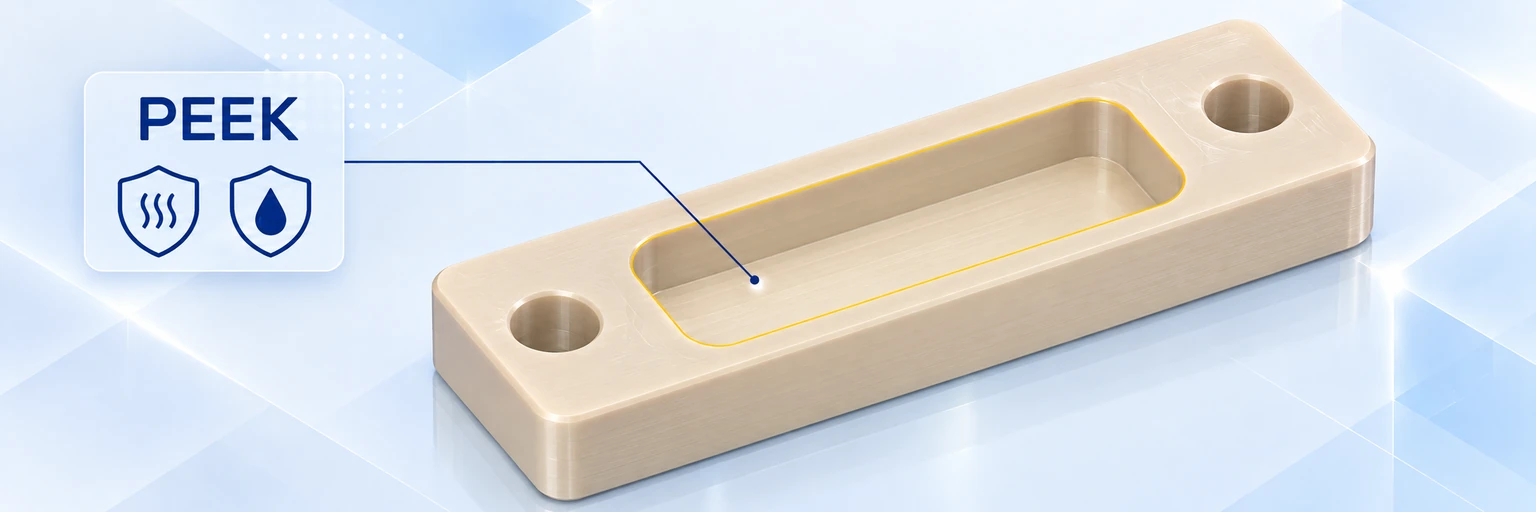
PEEK (polyether ether ketone) is a high-performance thermoplastic that combines a continuous service temperature of up to 260 °C with high strength, excellent chemical resistance and inherent flame retardancy. It is one of the most capable plastics available — and one of the most expensive — which is why it is used where metals are too heavy and standard plastics reach their thermal or chemical boundaries.
This guide explains the properties and grades of PEEK material, compares it with other engineering plastics, and gives practical tips for designing and machining PEEK parts.
What is PEEK?
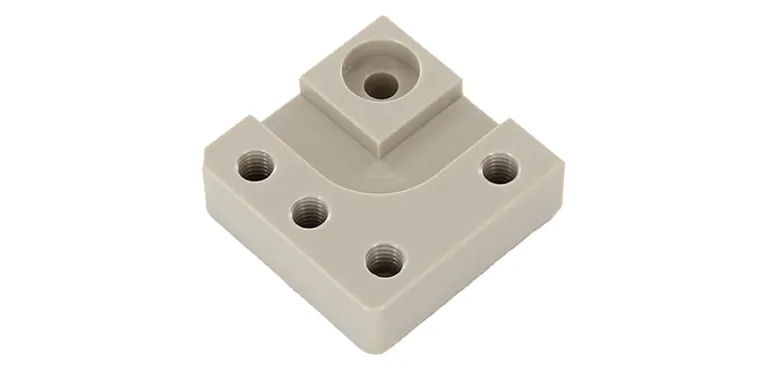
PEEK is a semi-crystalline thermoplastic from the polyaryletherketone (PAEK) family. It belongs to the high-performance or “super” engineering plastics, a step above engineering plastics such as POM and nylon. Its molecular chain of aromatic rings linked by ether and ketone groups gives PEEK its outstanding heat resistance, stiffness and chemical stability.
Unlike everyday plastics such as polyethylene or the transparent plastics used for covers and windows, PEEK is produced in comparatively small volumes for demanding applications — from semiconductor equipment and medical implants to aircraft and automotive components.
PEEK material properties
The values below refer to standard, unfilled PEEK. Mechanical values are meviy reference values; they are not guaranteed and vary with the grade.
| Property | Typical value |
|---|---|
| Tensile strength | Approx. 98–116 MPa |
| Flexural strength | Approx. 170–175 MPa |
| Young's modulus | Approx. 4,200–4,350 MPa |
| Elongation at break | Approx. 20–40% |
| Density | 1.32 g/cm³ |
| Continuous service temperature | Approx. 250–260 °C |
| Melting point | Approx. 343 °C |
| Glass transition temperature | Approx. 143 °C |
| Flammability | UL 94 V-0, inherently flame retardant without additives |
| Water absorption | Very low (approx. 0.5% when saturated) |
PEEK grades
PEEK is available in several grades, each modified for specific requirements:
| Grade | Composition | Main benefit | Typical use |
|---|---|---|---|
| Unfilled (standard) | Pure PEEK | Best toughness and chemical resistance | General machined parts, seals, insulators |
| Glass fibre reinforced | Usually 30% glass fibre | Higher stiffness and strength, lower thermal expansion | Structural parts, electrical components |
| Carbon fibre reinforced | Usually 30% carbon fibre | Highest strength and stiffness, low weight | Aerospace and high-load parts |
| Bearing grade | Carbon fibre, graphite and PTFE | Low friction and high wear resistance | Bushings, slide bearings, gears, piston rings |
| Conductive and anti-static | Carbon fibre or carbon black | Dissipates static charge | Semiconductor and electronics handling |
| Medical and food grades | Pure, certified PEEK | Biocompatibility (ISO 10993) or food contact (FDA, EU 10/2011) | Implants, surgical instruments, food machinery |
Advantages of PEEK
- Exceptional heat resistance: continuous service up to approx. 260 °C and a melting point of approx. 343 °C. PEEK withstands hot water and steam and can be sterilised by autoclave many times.
- High strength and stiffness: PEEK keeps its mechanical properties at high temperatures and shows excellent creep and fatigue resistance. Fibre reinforcement increases strength further.
- Outstanding chemical resistance: resistant to almost all acids, alkalis, oils and organic solvents — the main exceptions are concentrated sulphuric and nitric acid.
- Inherently flame retardant: UL 94 V-0 without flame retardant additives, with very low smoke and toxic gas emission.
- Dimensionally stable: very low water absorption, so dimensions remain stable in humid and wet environments.
- Clean and certified: low outgassing for vacuum and semiconductor use, high radiation resistance, and grades approved for food contact and medical applications.
Disadvantages of PEEK
- High cost: PEEK is many times more expensive than POM or nylon. It is only worth it where its properties are really needed.
- Moderate UV resistance: long-term outdoor exposure to sunlight degrades the surface unless the part is protected or pigmented.
- Demanding processing: injection moulding needs processing temperatures of approx. 360–400 °C and heated moulds.
- Machining needs care: PEEK machines well, but heat build-up and internal stresses must be controlled, and fibre-filled grades wear tools quickly.
PEEK vs other engineering plastics
PEEK is not always the best choice. This comparison with other plastics available for CNC machining shows when PEEK is worth its price (meviy reference values):
| Property | PEEK | PPS | POM | MC nylon |
|---|---|---|---|---|
| Tensile strength | 98–116 MPa | 79–85 MPa | 60–68 MPa | 96 MPa |
| Young's modulus | Approx. 4,300 MPa | Approx. 3,300 MPa | Approx. 3,000 MPa | Approx. 3,400 MPa |
| Density | 1.32 g/cm³ | 1.35 g/cm³ | 1.41 g/cm³ | 1.16 g/cm³ |
| Continuous service temperature | 250–260 °C | Approx. 220 °C | 95–100 °C | Approx. 120 °C |
| Chemical resistance | Excellent | Excellent (below 200 °C) | Good | Good (not against strong acids) |
| Water absorption | Very low | Very low | Low | High |
| Price | Very high | High | Low | Medium |
- Choose PEEK for temperatures above approx. 200 °C, aggressive chemicals, steam sterilisation or the highest mechanical demands.
- Choose PPS if you need high heat and chemical resistance up to approx. 200 °C at a lower price.
- Choose POM or MC nylon for general mechanical parts at normal temperatures. See also our comparison of PP vs ABS vs nylon.
Applications of PEEK
| Industry | Typical PEEK parts |
|---|---|
| Semiconductor and electronics | Wafer carriers, test sockets, insulators, CMP rings |
| Medical technology | Spinal implants, surgical instruments, sterilisable device components |
| Aerospace | Brackets, clips, bushings and cable insulation as metal replacement |
| Automotive | Thrust washers, seal rings, transmission and brake system components |
| Food and pharmaceutical | Valve seats, scrapers, guides and parts that are cleaned with steam |
| Chemical and oil and gas | Pump parts, valve components, seals and back-up rings |
Design and machining tips for PEEK parts
- Avoid sharp internal corners: fillets and radii distribute stress and increase the fatigue life of the part.
- Use material efficiently: PEEK stock is expensive, so keep part envelopes compact and avoid unnecessary material.
- Consider thermal expansion: PEEK expands much more than metal. For parts used at high temperatures or fitted into metal housings, allow for this in the tolerances and fits.
- Specify realistic tolerances: for tight tolerances, stress-relieved (annealed) stock and an annealing step between roughing and finishing reduce distortion.
- Use the right tools: sharp carbide tools work well for unfilled PEEK; diamond-coated or PCD tools are recommended for glass and carbon fibre grades, which are very abrasive.
- Control heat: moderate cutting speeds and cooling with air or a suitable coolant prevent overheating and keep surfaces clean.
Machined PEEK parts with meviy
meviy, the on-demand manufacturing platform by MISUMI, produces individually designed PEEK parts directly from your 3D CAD data — not catalogue or standard parts. PEEK (standard grade, grey-brown) is available for CNC milling and CNC turning.
- Instant price and lead time — compare PEEK with alternatives such as PPS, POM or MC nylon in seconds.
- Tolerances, threads and hole specifications are set directly in the 3D viewer — no 2D drawing required.
- Ideal for prototypes and small batches, where moulds for injection moulding are not economical.
Learn more about CNC machining with meviy.
Frequently asked questions about PEEK
What is PEEK material?
PEEK (polyether ether ketone) is a semi-crystalline high-performance thermoplastic. It offers a continuous service temperature of up to approx. 260 °C, high strength, excellent chemical resistance and inherent flame retardancy.
What temperature can PEEK withstand?
PEEK can be used continuously at approx. 250–260 °C and melts at approx. 343 °C. Its glass transition temperature is approx. 143 °C; above it, stiffness decreases, which fibre-reinforced grades largely compensate.
Why is PEEK so expensive?
PEEK is made from costly raw materials in a complex synthesis at high temperatures, and it is produced in much smaller volumes than standard plastics. Its price is many times higher than that of POM or nylon.
Is PEEK easy to machine?
Yes, unfilled PEEK machines well with sharp carbide tools. Heat build-up and internal stresses must be controlled, and glass or carbon fibre grades need diamond-coated tools because they are very abrasive.
What is the difference between PEEK and PPS?
Both are high-performance plastics with excellent chemical resistance and low water absorption. PEEK is stronger, tougher and withstands higher temperatures (approx. 260 °C vs approx. 220 °C), while PPS is more affordable.
Conclusion
PEEK material combines heat resistance up to approx. 260 °C, high strength, excellent chemical resistance and inherent flame retardancy like no other common thermoplastic. Its high price means it pays off where these properties are truly needed — in semiconductor, medical, aerospace, automotive and food applications. For less demanding parts, PPS, POM or MC nylon are often the more economical choice.