


Counterbore Hole: Features, Machining & Design Tips

A counterbore hole looks like a small detail on the drawing — but it decides whether your screw head sits flush, whether the assembly stays tight under vibration, and how much your part costs to machine.
How to design holes for components: useful tips

Sharing a common understanding on how components are manufactured is indeed the key to improving the procurement process for designers. This is why we are enriching our “meviy guide” for components design. This blog post focuses on the basic design considerations on hole machining. Let’s see what the different types of holes are and how to design holes for your custom mechanical parts avoiding some of the most common mistakes.
Edit 3D CAD’s hole specifications with meviy
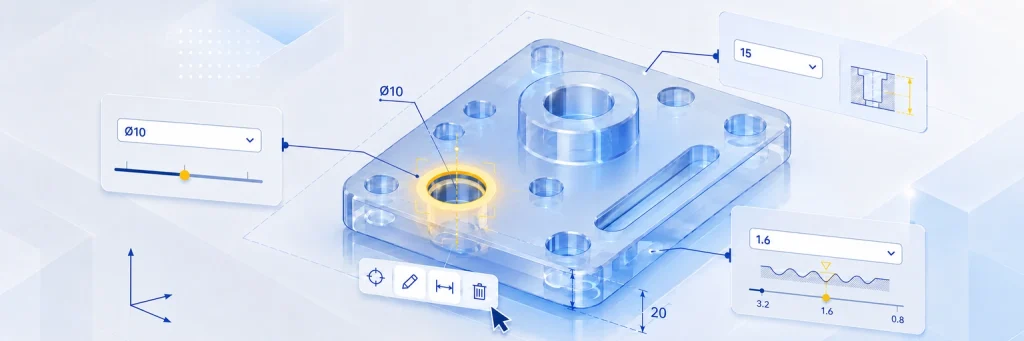
3D CAD ready, 2D drawing ready, quotation request sent — only to realise you need to adjust a single hole tolerance. And now the whole quotation process starts over. Sound familiar?
In a traditional procurement process, every change — even something as small as a hole tolerance — means requesting a new quote. That’s more hours finalising updated 2D and 3D drawings, re-requesting the quotation, and waiting again for the parts.
With meviy, none of that applies. After uploading only your 3D design, you can edit the 3D CAD’s hole specifications directly on screen and see the price and delivery date update instantly — with no new drawings needed on your side. You can change a specification such as a tolerance as often as you like and get the price and lead time in real time, all without ever drawing the 2D.
This is already a gamechanger for designers worldwide. Below are a few tips to help you get the most out of it.