


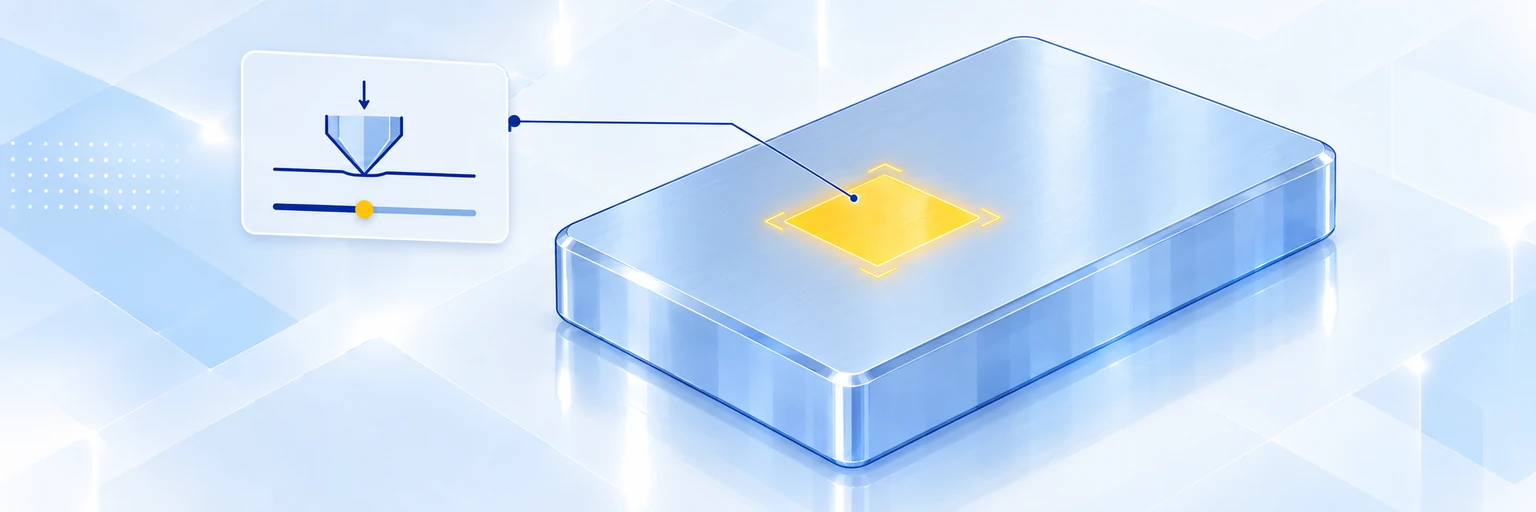
Metal hardness is a material's resistance to permanent indentation and wear. It determines how a part performs in use — and how difficult it is to machine. Hardness is measured with standardised tests such as Brinell (HB), Rockwell (HRC, HRB) and Vickers (HV), and each scale suits different materials.
This guide explains what metal hardness means, how the hardness tests work and compare, how to convert between scales, and how hardness affects tool choice, cutting parameters and part design in CNC machining.
What is metal hardness?
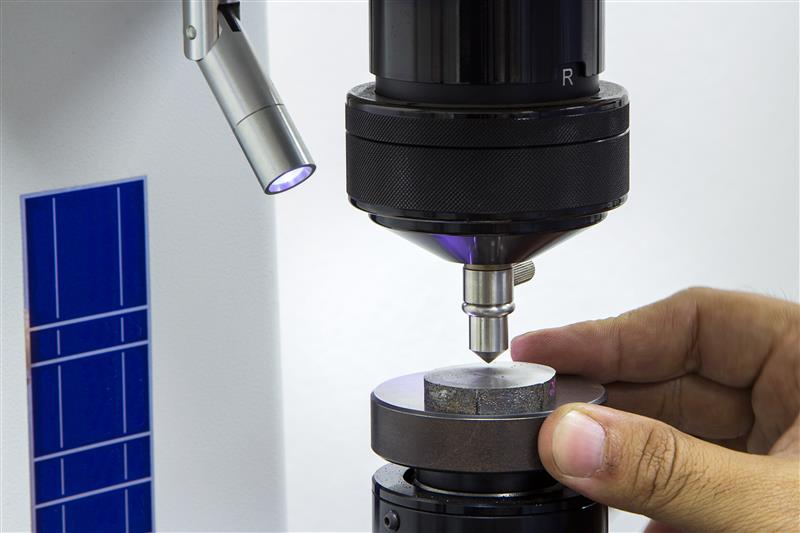
Metal hardness is the resistance of a metal to plastic deformation at its surface — usually measured by pressing a hard indenter into the material and evaluating the size or depth of the impression. Hard metals resist wear, abrasion and indentation; soft metals deform more easily but are easier to machine.
Hardness is related to, but not the same as, other mechanical properties:
- Strength is the resistance to breaking under load. For steels, tensile strength can be estimated from hardness: tensile strength in MPa ≈ 3.3 × Vickers hardness.
- Toughness is the ability to absorb energy without fracturing. Very hard steels are often brittle — high hardness usually means lower toughness.
- Wear resistance generally increases with hardness, which is why cutting tools, guides and dies are hardened.
Hardness tests: Brinell vs Rockwell vs Vickers
Three standardised tests are used for metals. They differ in the indenter, the test force and the way the result is measured:
| Test | Indenter | Measured value | Standard | Best for |
|---|---|---|---|---|
| Brinell (HBW) | Tungsten carbide ball, usually 10 mm | Diameter of the impression | ISO 6506 | Soft to medium-hard metals, castings, coarse-grained materials; up to approx. 650 HBW |
| Rockwell (HRC, HRB) | Diamond cone (HRC) or steel or carbide ball (HRB) | Depth of the impression | ISO 6508 | Fast testing in production: HRC for hardened steels, HRB for softer metals |
| Vickers (HV) | Square-based diamond pyramid, 136° | Diagonals of the impression | ISO 6507 | All metals from soft to very hard, thin parts, coatings and surface layers |
Brinell hardness (HBW)
A tungsten carbide ball is pressed into the surface with a defined force, and the diameter of the impression is measured. Because the impression is large, Brinell averages over the microstructure, which makes it ideal for castings and coarse-grained materials. Mild steel, for example, has a hardness of about 120–140 HBW. Steel balls are no longer permitted in the current standard, which is why the symbol is HBW.
Rockwell hardness (HRC, HRB)
Rockwell measures the depth of the impression and shows the result directly on the machine, so it is fast and widely used in production and incoming inspection. The scale defines the indenter and force: HRC uses a diamond cone and is the standard for hardened and tool steels — hardened tool steel reaches 58–64 HRC. HRB uses a ball and covers softer metals such as copper alloys, soft steels and aluminium.
Vickers hardness (HV)
A square-based diamond pyramid creates a small impression whose diagonals are measured under a microscope. Vickers covers the entire hardness range with one scale and, with low test forces, also measures thin parts, case-hardened layers and coatings (microhardness). Hard chrome plating, for example, reaches about 800–1,000 HV.
Hardness conversion: HV, HB and HRC
There is no exact formula to convert between hardness scales, because each test deforms the material differently. Approximate conversion tables for steels are given in ISO 18265. Use them for orientation only — for acceptance tests, always measure in the scale specified on the drawing.
| Vickers (HV) | Brinell (HBW) | Rockwell |
|---|---|---|
| 150 | Approx. 143 | Approx. 79 HRB |
| 200 | Approx. 190 | Approx. 92 HRB |
| 250 | Approx. 238 | Approx. 22 HRC |
| 300 | Approx. 284 | Approx. 30 HRC |
| 400 | Approx. 379 | Approx. 41 HRC |
| 500 | Approx. 471 | Approx. 49 HRC |
| 600 | Approx. 564 | Approx. 55 HRC |
| 700 | – | Approx. 60 HRC |
| 800 | – | Approx. 64 HRC |
Typical hardness of common metals
The hardness of a metal depends strongly on its alloy and condition (annealed, cold-worked, hardened). These approximate values help with material choice and machining planning:
| Material | Condition | Typical hardness |
|---|---|---|
| Aluminium alloys (EN AW-5052, EN AW-6061) | Work-hardened or age-hardened | Approx. 60–95 HBW |
| Copper (Cu-ETP) | Annealed to cold-worked | Approx. 40–100 HBW |
| Brass (CW614N) | Drawn bar | Approx. 90–150 HBW |
| Structural steel S235 (EN 1.0038) | As rolled | Approx. 120–140 HBW |
| Carbon steel C45 (EN 1.1191) | Normalised | Approx. 170–210 HBW |
| Stainless steel EN 1.4301 | Annealed | Approx. 150–200 HBW |
| Alloy steel 42CrMo4 (EN 1.7220) | Quenched and tempered | Approx. 26–32 HRC |
| Titanium Ti-6Al-4V | Annealed | Approx. 30–36 HRC |
| Tool steel EN 1.2379 | Hardened and tempered | Approx. 58–63 HRC |
Learn more about the materials in our guides to carbon steel, stainless steel and copper alloys.
How metal hardness affects CNC machining
Tool choice
The harder the workpiece, the harder and more heat-resistant the cutting tool must be:
| Workpiece hardness | Typical materials | Recommended tools |
|---|---|---|
| Soft (below approx. 150 HBW) | Aluminium, copper, brass, mild steel | HSS or uncoated carbide with sharp edges |
| Medium (approx. 150–300 HBW) | Carbon steels, stainless steels, pre-hardened steels | Coated carbide |
| Hard (approx. 45–65 HRC) | Hardened tool steels and bearing steels | Coated carbide for hard machining, CBN, ceramics; grinding for finishing |
Hardness is not the only factor. Titanium and nickel-based alloys such as Inconel are difficult to machine even though they are not extremely hard: they conduct heat poorly and work-harden, so they need sharp carbide tools, low cutting speeds and plenty of coolant.
Cutting parameters
As hardness increases, cutting parameters must be reduced to keep tool wear and heat under control:
| Hardness | Cutting speed | Feed rate | Depth of cut | Tool wear |
|---|---|---|---|---|
| Low (below approx. 150 HBW) | High | Medium to high | Medium to high | Low |
| Medium (approx. 150–300 HBW) | Medium | Medium | Medium | Medium |
| High (above approx. 300 HBW / 30 HRC) | Low | Low | Low | High |
Wrong parameters lead to chipped tools, overheating, poor surface finish and dimensional errors.
Soft vs hard metals in CNC machining
Soft metals such as aluminium, copper, brass and mild steel are quick to machine:
- High cutting speeds and short machining times.
- Long tool life and good surface finish.
- Aluminium and copper alloys also offer good corrosion resistance.
Their drawbacks: lower strength and wear resistance, and soft, ductile materials can form burrs and built-up edges on the tool.
Hard metals such as hardened tool steels and martensitic stainless steels deliver performance:
- High strength and excellent wear resistance.
- Dimensional stability under load, ideal for guides, dies, shafts and wear parts.
Their drawbacks: slower machining, higher tool wear and cost, and the need for rigid machines, special tools and effective cooling.
Design tips for hard materials
Hardness should influence the geometry, tolerances and manufacturing route of a part from the start:
- Keep geometry simple: avoid deep pockets, thin walls and small internal radii in hard materials — they cause tool deflection and long machining times.
- Add fillets and chamfers: they reduce stress concentrations and the risk of cracking during hardening.
- Use realistic tolerances: very tight tolerances on hardened parts increase cost significantly.
- Machine soft, then harden: if the final part must be very hard, machine it in the soft or pre-hardened state, apply heat treatment and finish only the critical surfaces afterwards.
- Consider pre-hardened steels: quenched and tempered steels with around 30 HRC can be machined directly and often need no further heat treatment.
Hardened and pre-hardened steel parts with meviy
meviy, the on-demand manufacturing platform by MISUMI, produces individually designed parts directly from your 3D CAD data — not catalogue or standard parts. For parts that need a defined hardness, meviy offers both pre-hardened materials and heat treatment for CNC milling:
- Pre-hardened and tempered steels: EN 1.1206 equiv. (reference hardness 20–34 HRC), EN 1.7220 equiv. (26–32 HRC) and NAK55 equiv. (37–43 HRC).
- Hardening to your required hardness: EN 1.2379 equiv. up to 63 HRC, EN 1.7220 equiv. up to 55 HRC and EN 1.1206 equiv. up to 50 HRC — the minimum hardness you specify is guaranteed.
- Soft materials for fast machining: aluminium, copper, brass and plastics for both milling and CNC turning.
Upload your model, choose the material and heat treatment, and get the price and lead time instantly. Learn more about CNC machining with meviy.
Frequently asked questions about metal hardness
What is metal hardness?
Metal hardness is the resistance of a metal to permanent indentation, scratching and wear. It is measured by pressing a hard indenter into the surface and evaluating the impression, for example with the Brinell, Rockwell or Vickers test.
What is the difference between HRC, HB and HV?
They are different hardness scales. HRC (Rockwell C) measures the indentation depth of a diamond cone and is used for hardened steels. HB (Brinell) measures the diameter of a ball impression and suits softer metals. HV (Vickers) measures the diagonals of a pyramid impression and covers all hardness levels.
How do you convert HRC to HV or HB?
Use conversion tables according to ISO 18265, which are valid for steels only. For example, 30 HRC corresponds to about 300 HV and 284 HBW, and 55 HRC to about 600 HV. Conversions are approximate and do not replace a measurement.
Which metals are hardest to machine?
Hardened tool steels above about 45 HRC are the hardest to cut and often need CBN tools or grinding. Titanium and nickel-based alloys are also difficult — not because they are very hard, but because they conduct heat poorly and work-harden.
Should I machine steel before or after hardening?
Usually before. Machining in the soft or pre-hardened state is faster and cheaper. After hardening, only critical surfaces are finished, for example by hard milling or grinding, to correct distortion and achieve tight tolerances.
Conclusion
Metal hardness describes how well a material resists indentation and wear, and it is measured with the Brinell, Rockwell and Vickers tests. The harder the metal, the more wear-resistant the part — but the slower and more expensive the machining. Choose the hardness the function really needs, use pre-hardened steels or machine soft before hardening, and adjust tools and cutting parameters to the material.