


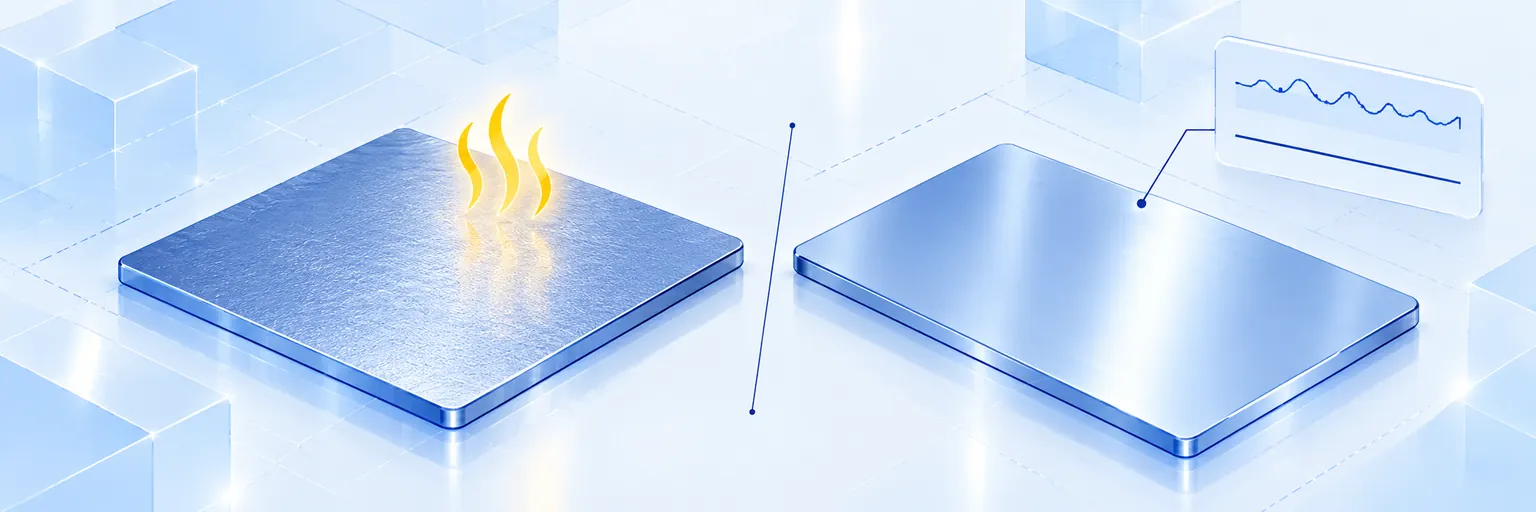
Hot rolled and cold rolled steel sheets are among the most widely used materials in manufacturing. Both are inexpensive and easy to bend and fabricate — but they differ in surface, accuracy and cost. Knowing these differences helps you choose the right sheet for your part.
This article explains what rolled steel sheets are, how hot rolled steel sheet (SPHC) and cold rolled steel sheet (SPCC) differ, where each is used, and how to choose between them.
What are rolled steel sheets?
Rolled steel sheets are flat steel products made by rolling. They are relatively inexpensive and well suited to bending. Thanks to their flat shape, they are ideal for pressing and sheet metal fabrication, and they are commonly used for non-structural parts such as covers, panels and enclosures.
Hot rolling vs. cold rolling in brief
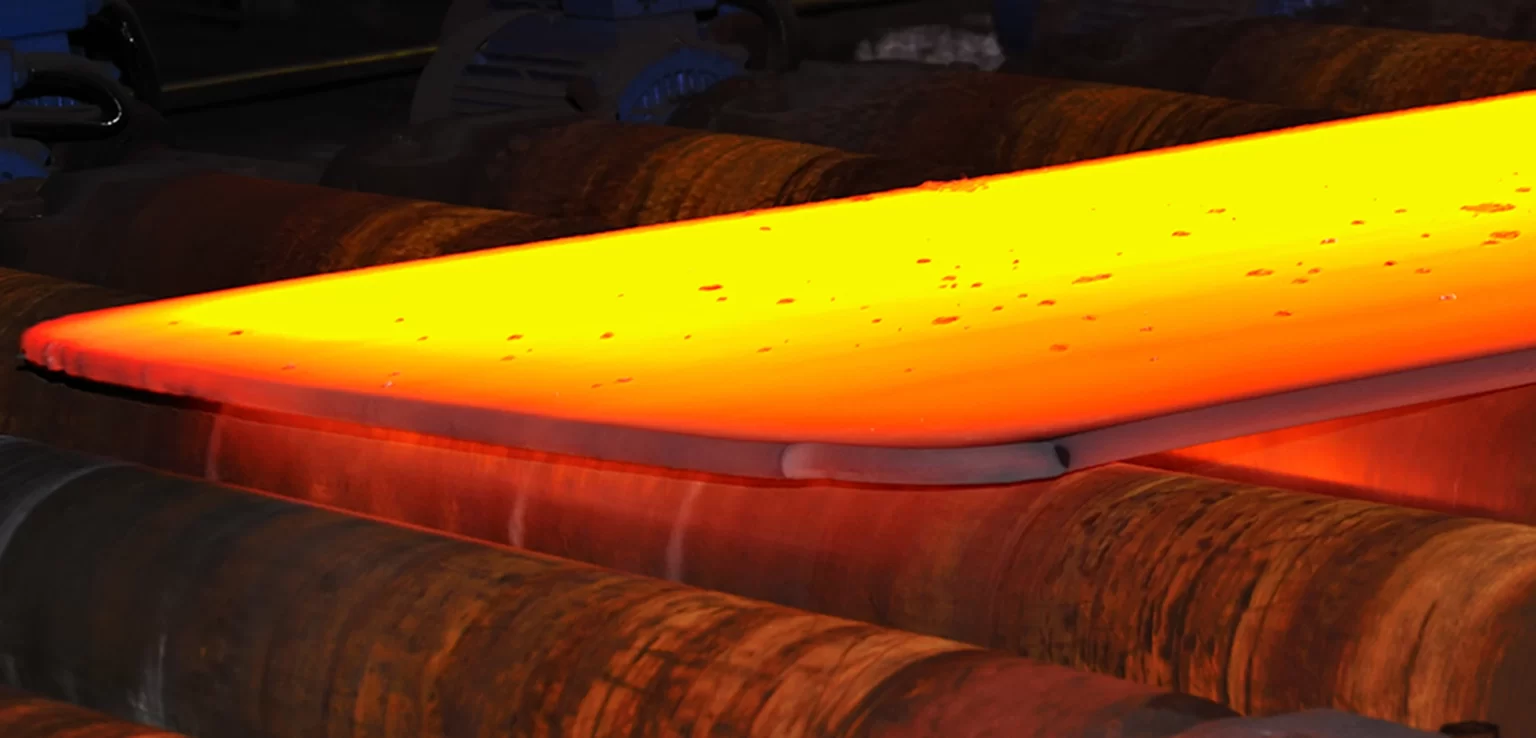
Rolled steel sheets are divided by their rolling temperature. Hot rolled sheet is rolled above the recrystallization temperature of the steel — typically at around 900–1,200 °C. This requires less force but leaves an oxide layer (scale) on the surface and limits dimensional accuracy. Cold rolled sheet is rolled further at room temperature, below the recrystallization temperature. It achieves tighter tolerances and a smooth, bright surface, but requires more force and causes work hardening. You can find a detailed explanation of both processes and the rolling mills used in our article on the rolling process.
In the Japanese JIS standard, which is common in international data sheets, hot rolled steel sheet for general use is designated SPHC, and cold rolled steel sheet SPCC.
SPHC vs. SPCC at a glance
| Property | SPHC (hot rolled) | SPCC (cold rolled) |
|---|---|---|
| Rolling | Above recrystallization temperature | At room temperature |
| Surface | Dark mill scale, rougher | Smooth and bright |
| Dimensional accuracy | Lower | High |
| Typical thickness | Thicker sheet and plate | Thin sheet |
| Formability | Good — easy to bend and weld | Very good — easy to bend, stamp and paint |
| Corrosion | Rusts without protection; scale offers only limited protection | Rusts without protection; needs a coating |
| Cost | Lower | Higher than SPHC, lower than stainless steel |
| Typical uses | Frames, brackets, chassis parts, large covers | Body panels, appliance housings, electronic enclosures |
| Comparable European grade | DD11 (EN 10111) | DC01 (EN 10130, 1.0330) |
What is SPHC (hot rolled steel sheet)?
SPHC stands for "Steel Plate Hot Commercial" — a hot rolled steel sheet for general use. It is relatively inexpensive and, thanks to its good workability, very well suited to bending. SPHC belongs to the general-purpose steels rather than the structural steels, so its strength is lower than that of structural steels such as SS400 — more on this in our carbon steel guide.
During hot rolling, an oxide layer forms on the surface, known as mill scale or "black skin". It offers some protection against corrosion and scratches, but it is far less reliable than a coating or plating.
Applications of SPHC
SPHC is a general-purpose material and is not typically used for structural components that require high strength. Because its strength is not guaranteed, it is not recommended for safety-relevant applications. Its good bendability makes it a common choice for vehicle frames, brackets and chassis parts as well as electrical cabinets, and its low price makes it suitable for large parts such as covers and exterior panels.
Advantages of SPHC
- Cost-effective: SPHC is cheaper than most other steel sheets, which makes it an economical choice for large parts and high volumes.
- Good formability: it can be shaped, bent and welded easily.
- Good ductility and toughness: hot rolling gives the material sufficient strength for many general-purpose applications.
Disadvantages of SPHC
- Lower dimensional accuracy: hot rolling causes variations in thickness and surface irregularities, which makes SPHC less suitable for parts that need tight tolerances and a smooth finish.
- Mill scale: the scale on the surface may need to be removed or treated before painting or plating.
- Limited strength and hardness: SPHC does not reach the tensile strength and hardness of specialised steel grades, so it is not suitable for highly loaded parts.
What is SPCC (cold rolled steel sheet)?
SPCC is a cold rolled steel sheet for general use, known for its smooth surface and high precision. Because it is rolled at room temperature, it offers excellent dimensional accuracy and a clean, bright appearance — ideal for visible parts and fine details. Its very good formability makes it suitable for a wide range of uses, from automotive parts to household appliances. Like any uncoated carbon steel, however, SPCC rusts easily and usually needs a surface treatment such as painting or zinc plating — zinc-plated cold rolled sheet is explained in our article on SECC vs. SGCC.
Applications of SPCC
SPCC is used wherever surface quality and formability matter. In the automotive industry, it is used for body panels and other parts that need a precise, smooth finish. It is also common in household appliances such as refrigerators, washing machines and microwave ovens, where appearance and durability are both important. In addition, SPCC is used for office equipment, furniture and electronic enclosures, because it is easy to stamp, form and paint. With the right surface treatment, its service life can be extended considerably.
Advantages of SPCC
- Attractive surface: SPCC has a smooth, bright surface that looks clean even without further finishing.
- Very good workability: it is easy to bend, stamp and form.
- High precision: cold rolling gives it high dimensional accuracy.
- Cost-effective: although more expensive than SPHC, it is still affordable compared with stainless steel and other high-end materials.
Disadvantages of SPCC
- Prone to rust: without protection, SPCC rusts quickly. It should be painted or plated soon after processing and is not suitable for long-term storage without protective measures.
How to choose between hot rolled and cold rolled sheet
As a rule of thumb, choose hot rolled sheet when price matters most and cold rolled sheet when you need thin, precise parts. In more detail:
- Cost first: choose hot rolled sheet for large, cost-sensitive parts where surface and tolerances are less critical.
- Thickness: thin sheet is usually cold rolled; thicker sheet and plate are usually hot rolled.
- Visible surfaces: choose cold rolled sheet for parts that will be painted, coated or seen.
- Tight tolerances: choose cold rolled sheet when thickness accuracy and flatness are important.
- Corrosion: plan a surface treatment for both — or choose zinc-plated sheet or stainless steel from the start.
Rolled steel sheet for parts from meviy
meviy manufactures individually designed custom parts from your own 3D CAD data — not standard or catalogue parts. For parts made by sheet metal fabrication, you can choose low-carbon steel sheet and protect it with the surface treatment that suits your application:
- EN 1.0330 equiv. (EN 1.0320 equiv. [hot coiled]) from 0.8 to 6.0 mm, uncoated or with powder coating, painting, electroless nickel plating, black oxide or trivalent chromate
- Zinc-plated variants EN 1.0330 equiv. (Electrolytic Zinc Plating) and EN 1.0330 equiv. (Galvanized)
- EN 1.0038 equiv. for thicker plates from 9 to 16 mm
- Blanks cut by laser cutting, formed by bending and, if required, joined into assemblies by welding
- Instant price and lead time from your 3D model — no 2D drawing required
Frequently asked questions about hot and cold rolled steel
What is the difference between hot rolled and cold rolled steel?
Hot rolled steel is rolled above its recrystallization temperature. It is cheaper, easier to form and has a scaled surface, but lower dimensional accuracy. Cold rolled steel is rolled at room temperature: it has a smooth surface, tighter tolerances and higher strength from work hardening, but costs more.
Is SPCC the same as DC01?
They are comparable. SPCC is the JIS designation for cold rolled steel sheet for general use; DC01 (1.0330) is the corresponding grade in the European standard EN 10130. Their compositions and properties are very similar but not identical in every detail.
What is the European equivalent of SPHC?
The comparable European grade for hot rolled sheet for cold forming is DD11 according to EN 10111. As with all cross-standard comparisons, the grades are similar but not identical.
Does hot rolled steel rust despite its scale?
Yes. The mill scale offers only limited, temporary protection and can flake off. For lasting corrosion protection, hot rolled steel needs a coating or plating, just like cold rolled steel.
Choosing the right rolled steel sheet
Hot rolled steel sheet (SPHC) and cold rolled steel sheet (SPCC) are among the most common general-purpose steel sheets. As a rough guide, choose SPHC when you want to keep the price low and SPCC when you need thin, highly precise parts. Understanding their basic properties helps you make the right choice for every design.