



Stainless steel comes in many grades, and two of the most common are EN 1.4305 equiv. (AISI 303 / SUS303) and EN 1.4301 equiv. (AISI 304 / SUS304). Choosing between them depends on how the part will be manufactured, where it will be used and what it may cost.
1.4305 is a variant of 1.4301 – the most widely used stainless steel – that was developed for better machinability. This makes it particularly well suited for machined parts. In return, it offers lower corrosion resistance and is not suitable for welding. In this article, we explain the basics of stainless steel, take a closer look at both grades, and show you the differences between 1.4305 and 1.4301 so you can choose the right material for your parts.
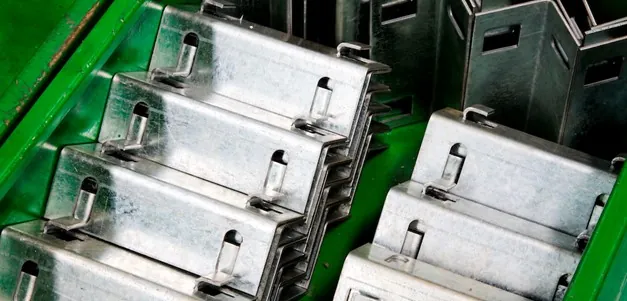
Stainless steel basics
Stainless steel is a corrosion-resistant alloy steel. According to EN 10088, it consists mainly of iron and contains at least 10.5% chromium. The chromium forms a thin, self-healing passive layer on the surface that protects the steel against corrosion.
There are many types of stainless steel, each with its own properties. In Europe, they are identified by EN material numbers such as 1.4305 or 1.4301, often together with a designation that describes the composition, for example X5CrNi18-10. Internationally, the same grades are also known by their AISI numbers (303, 304) or Japanese JIS designations (SUS303, SUS304). Both 1.4305 and 1.4301 belong to the austenitic 300 series.
What is 1.4305 (303)?
EN 1.4305 (X8CrNiS18-9, AISI 303) is an austenitic stainless steel based on 1.4301 with added sulphur (0.15–0.35%). The sulphur forms manganese sulphide inclusions that act as chip breakers: chips break short instead of forming long strands. This makes 1.4305 one of the best stainless steels for machining. It also has good resistance to galling, so mating parts are less likely to seize.
Like 1.4301, it is non-magnetic in the solution-annealed condition. Cold working can make it slightly magnetic.
What is 1.4301 (304)?
EN 1.4301 (X5CrNi18-10, AISI 304) is the most widely used stainless steel. This austenitic steel contains around 18% chromium and 8–10.5% nickel, which gives it very good corrosion resistance, toughness and formability. It is non-magnetic in the solution-annealed condition, can be welded very well and is easy to form, which is why it is used for everything from kitchen equipment and architecture to industrial plants. Wherever corrosion resistance matters, 1.4301 is usually the first choice.
1.4305 vs 1.4301: the key differences
The basic properties of both grades are similar, but the added sulphur in 1.4305 makes a clear difference:
| Property | EN 1.4305 (303) | EN 1.4301 (304) |
|---|---|---|
| EN designation | X8CrNiS18-9 | X5CrNi18-10 |
| AISI / JIS | 303 / SUS303 | 304 / SUS304 |
| Microstructure | Austenitic | Austenitic |
| Sulphur content | 0.15–0.35% | Very low |
| Machinability | Very good | Moderate |
| Corrosion resistance | Good | Very good |
| Weldability | Not recommended | Very good |
| Cold formability | Limited | Very good |
| Material price | Usually slightly higher | Reference grade |
| Available at meviy | CNC milling, CNC turning | CNC milling, CNC turning, sheet metal fabrication |
- Corrosion resistance: the manganese sulphide inclusions in 1.4305 are starting points for pitting corrosion. In corrosive or humid environments, use 1.4301 rather than 1.4305.
- Weldability: the sulphur in 1.4305 makes it prone to hot cracking during welding. If the part needs to be welded, choose 1.4301.
- Machinability: thanks to the added sulphur, 1.4305 produces short chips and can be machined faster and with less tool wear than 1.4301.
- Price: 1.4305 is usually slightly more expensive per kilogram than 1.4301. For parts with a lot of machining, the shorter machining time can make up for this.
How to tell 1.4305 and 1.4301 apart
1.4305 and 1.4301 look almost identical, so they are hard to distinguish visually. One practical method is to compare the chips produced during machining: 1.4301 forms long, continuous chips, while 1.4305 produces short, broken chips. The most reliable way, however, is to check the material certificate (inspection certificate 3.1 according to EN 10204) or to have the composition determined by spectrometric analysis.
Typical applications of 1.4305 and 1.4301
1.4305 is mainly used for parts that require a lot of machining, such as screws, nuts, bolts, shafts, pins and other turned parts, as well as machine components. It is usually supplied as round bar and processed into a wide range of shapes.
Thanks to its higher corrosion resistance, 1.4301 is used in a much wider range of applications: in food processing and kitchen equipment, pharmaceutical and medical equipment, architecture and building technology (for example handrails, escalators and automatic doors), vehicle construction and industrial plants. It is also commonly used for screws, nuts and other industrial products.
Which one should you choose?
As a rule of thumb, choose 1.4305 when:
- The part requires a lot of machining, for example complex turned parts
- The part will not be welded
- It will be used in a dry or only mildly corrosive environment
Choose 1.4301 when:
- Corrosion resistance is the priority, for example in humid or outdoor environments
- The part will be welded or formed, for example as a sheet metal part
- It is used in food processing, pharmaceutical or medical applications
1.4305 and 1.4301 parts you can order with meviy
With meviy, you can order individually designed custom parts made from your own 3D CAD data – no standard or catalogue parts. Both stainless steels are available as Stainless Steel EN 1.4305 equiv. and EN 1.4301 equiv. for CNC milling and CNC turning. For sheet metal fabrication, you can choose EN 1.4301 equiv. Simply upload your 3D model, select the material and get the price and delivery date instantly – no 2D drawing required.
Frequently asked questions about 1.4305 and 1.4301
Which is more corrosion resistant, 1.4305 or 1.4301?
1.4301 (304) is more corrosion resistant. The added sulphur in 1.4305 (303) forms manganese sulphide inclusions, which are starting points for pitting corrosion.
Can 1.4305 be welded?
1.4305 is not recommended for welding, because its sulphur content makes it prone to hot cracking. For welded parts, use 1.4301 instead.
Are 1.4305 and 1.4301 magnetic?
Both are austenitic stainless steels and non-magnetic in the solution-annealed condition. After cold working, for example machining or forming, they can become slightly magnetic.
What are the AISI and JIS equivalents of 1.4305 and 1.4301?
EN 1.4305 corresponds to AISI 303 and JIS SUS303. EN 1.4301 corresponds to AISI 304 and JIS SUS304.
Conclusion
1.4305 and 1.4301 are both austenitic stainless steels from the 300 series, alloyed with chromium and nickel to resist corrosion. 1.4305 contains added sulphur, which makes it much easier to machine and less prone to galling, but reduces its corrosion resistance and weldability. 1.4301 is the more versatile all-rounder for corrosive environments, welded parts and sheet metal. At meviy, you can get instant quotes for parts made of both materials.