



Copper is one of the most widely used non-ferrous metals — and together with its alloys brass, bronze and cupronickel, it is a material family every designer should know. Copper alloys combine excellent electrical and thermal conductivity with good formability and corrosion resistance.
This article explains the properties of copper, the different types of pure copper and copper alloys, how to read copper alloy designations, and what to keep in mind when machining copper and brass parts.
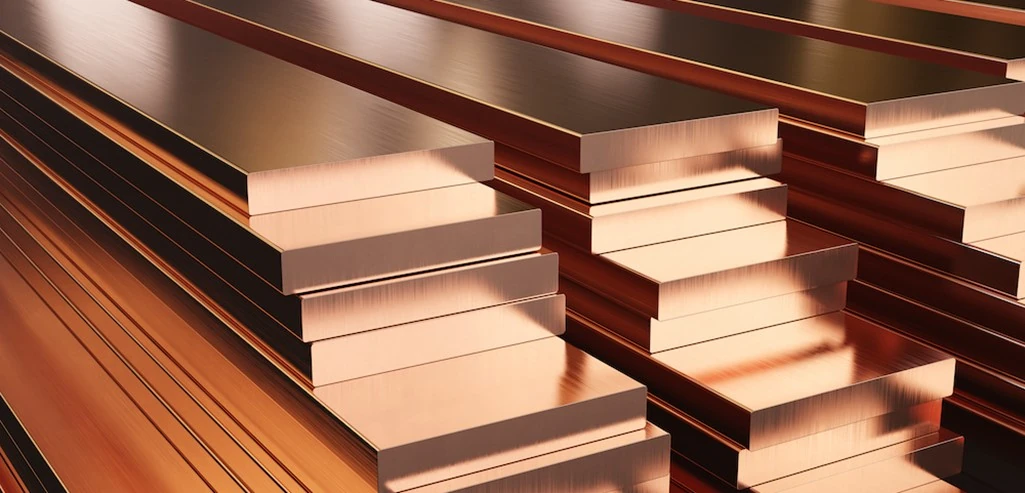
Key properties of copper
Copper (Cu) is an important non-ferrous metal that is used in industry almost as widely as aluminium. Its key properties:
- Excellent electrical and thermal conductivity — second only to silver among the metals
- Soft, very ductile and easy to form
- Does not become brittle at low temperatures
- Fully recyclable without loss of quality
- Good corrosion resistance thanks to a protective surface layer that forms over time
- Antimicrobial, which makes it suitable for high-touch surfaces and plumbing
- Attractive reddish colour, popular for decorative building materials
On the downside, copper is heavier than steel: its density of about 8.9 g/cm³ is higher than that of iron.
Types of pure copper
Pure copper refers to copper materials with a copper content of 99.90 % or higher. Depending on their oxygen content, they are divided into three main types:
| Type | Designation | Oxygen | Conductivity | Hydrogen embrittlement | Typical uses |
|---|---|---|---|---|---|
| Oxygen-free copper | Cu-OF, CW008A (JIS C1020) | Virtually none | Very high | Not susceptible | Electronics, vacuum technology, brazed and welded parts |
| Electrolytic tough pitch copper | Cu-ETP, CW004A (JIS C1100) | Small amount | Very high | Susceptible when heated in reducing atmospheres | Busbars, cables, electrical components |
| Phosphorus-deoxidised copper | Cu-DHP, CW024A (JIS C1220) | None; contains residual phosphorus | Lower | Not susceptible | Pipes, heat exchangers, brazed and welded components |
Electrolytic tough pitch copper is the most common type. Its small oxygen content makes it susceptible to hydrogen embrittlement when it is welded or brazed, or annealed in a hydrogen-containing atmosphere. For such applications, oxygen-free or deoxidised copper is the better choice.
Properties of pure copper
Among the copper materials, pure copper has the highest electrical and thermal conductivity. It is non-magnetic. Typical values:
| Property | Value |
|---|---|
| Density | 8.89–8.94 g/cm³ |
| Tensile strength | Approx. 220–360 N/mm², depending on temper |
| Hardness | Approx. 40–110 HV, depending on temper |
| Young's modulus | Approx. 117 kN/mm² |
| Electrical conductivity | Approx. 100 % IACS |
| Coefficient of thermal expansion | 16.8 × 10⁻⁶/K |
| Thermal conductivity | Approx. 390–398 W/(m·K) |
| Melting point | Approx. 1,083 °C |
| Boiling point | Approx. 2,560 °C |
Advantages and disadvantages of pure copper
Advantages
- Highest electrical and thermal conductivity of all copper materials
- Soft and easy to form
- Good corrosion resistance in the atmosphere and in water
Disadvantages
- Heavy compared with steel and aluminium
- Tarnishes over time; contact surfaces or visible parts are often plated
- Its softness and stickiness make machining more demanding than with brass
Types of copper alloys
Copper alloys easily with other metals, which changes its properties considerably. The table gives an overview of the most important groups; the sections below explain each one.
| Alloy | Main alloying element | Key properties | Typical uses | EN example |
|---|---|---|---|---|
| Brass | Zinc | Very good machinability, golden colour | Fittings, valves, turned parts, connectors | CW614N (CuZn39Pb3), CW509L (CuZn40) |
| Bronze | Tin | Harder, wear-resistant, corrosion-resistant | Bearings, bushings, gears, springs | CW453K (CuSn8) |
| Cupronickel | Nickel | Excellent seawater resistance, silvery colour | Marine piping, heat exchangers, coins | CW352H (CuNi10Fe1Mn) |
| High-copper alloys | Small amounts of e.g. beryllium or chromium | Near-copper conductivity with higher strength | Springs, contacts, electrodes | CW101C (CuBe2) |
Brass
Brass is an alloy of copper and zinc. It offers excellent ductility, good hot forging properties and very good machinability, and it is slightly lighter than pure copper. Its golden sheen makes it popular for visible parts. Free-cutting brass such as CW614N contains a small amount of lead, which breaks chips short and makes it one of the easiest metals to machine. For drinking water applications, lead-free brass grades are required.
Bronze
Bronze is copper alloyed with tin. In the atmosphere, it slowly forms a green patina. Bronze is harder than pure copper and has a lower melting point, which made it one of the first metals used by humans. Today, it is used for plain bearings, bushings, gears, springs and marine fittings, as well as for bells and sculptures.
Cupronickel
Cupronickel is copper alloyed with nickel, often with small additions of iron and manganese. It has a silvery colour and excellent resistance to seawater, which is why it is used for marine piping, heat exchangers and coins.
High-copper alloys
High-copper alloys contain more than 96 % copper. They offer thermal and electrical conductivity close to pure copper while providing higher strength and heat resistance. They are used in precision devices such as computers and smartphones and in automotive components. Their properties depend on the added elements: beryllium copper, for example, combines electrical conductivity with excellent spring properties.
How to read copper alloy designations
In Europe, copper materials are designated according to EN 1412 with a six-character code, for example CW614N:
- C stands for copper.
- The second letter indicates the product form: W for wrought products such as bars, sheets and tubes, C for castings.
- The three-digit number identifies the individual material.
- The final letter indicates the material group: for example A or B for copper, C or D for low-alloyed copper, H for copper-nickel, K for copper-tin (bronze), L or M for copper-zinc (brass) and N or P for copper-zinc-lead (free-cutting brass).
CW614N is therefore a wrought copper-zinc-lead alloy — a free-cutting brass. Alongside the number, the chemical composition is often given, such as CuZn39Pb3.
International data sheets often use the Japanese JIS designation instead: a "C" followed by four digits, such as C1100 for electrolytic tough pitch copper or C3604 for free-cutting brass. The first digit indicates the alloy group, for example 1 for copper and high-copper alloys, 2 for brass and 3 for leaded brass.
Machining tips for copper and brass
Copper and its alloys are soft, which makes them easy to cut — but the softness also creates challenges, especially with pure copper.
- Burrs: pure copper is soft and very ductile, so it tends to form burrs and smear during cutting.
- Built-up edge: the sticky material adheres to the cutting edge and forms a built-up edge, which degrades the surface and dimensional accuracy.
- Heat: machining generates heat that must be dissipated with coolant. Some water-based coolants can stain copper, so oil-based or copper-compatible coolants are often recommended.
To reduce cutting resistance, use sharp tools with a large positive rake angle and work at high cutting speeds. Free-cutting brass such as CW614N is much easier: its short chips allow fast, clean machining of complex turned and milled parts. You can find more on the processes themselves in our articles on the turning process and the milling process.
Copper and brass parts from meviy
meviy manufactures individually designed custom parts from your own 3D CAD data — not standard or catalogue parts. You can choose from these copper materials:
| Material | Type | Available for |
|---|---|---|
| EN CW008A equiv. (Oxygen-free) | Oxygen-free copper | CNC milling |
| EN CW004A equiv. (ETP) | Electrolytic tough pitch copper | CNC milling |
| EN CW509L equiv. (Brass) | Brass | CNC milling |
| EN CW614N equiv. | Free-cutting brass | CNC milling and CNC turning |
- Busbars, contacts and heat sinks in pure copper made by CNC milling
- Bushings, fittings, pins and connectors in brass made by CNC turning
- Instant price and lead time for CNC machining — no 2D drawing required
Frequently asked questions about copper alloys
What is the difference between copper, brass and bronze?
Copper is the pure metal. Brass is an alloy of copper and zinc with very good machinability and a golden colour. Bronze is an alloy of copper and tin that is harder and more wear-resistant, which makes it ideal for bearings and bushings.
Is copper magnetic?
No. Pure copper is non-magnetic, as are common brass and bronze grades. This makes copper materials suitable for applications near sensitive electronics and magnetic fields.
Which copper material is easiest to machine?
Free-cutting brass such as CW614N (CuZn39Pb3). Its lead content breaks chips short, so it can be machined quickly with very good surface quality. Pure copper is much more demanding because it is soft and sticky.
What is the difference between CW004A and CW008A?
CW004A (Cu-ETP) contains a small amount of oxygen and is the standard copper for electrical applications. CW008A (Cu-OF) is oxygen-free, so it is not susceptible to hydrogen embrittlement and is preferred for welded, brazed and vacuum applications.
Choosing the right copper material
Copper is a non-ferrous metal used almost as widely as aluminium. It offers high thermal and electrical conductivity and is easy to recycle. Its alloy family includes pure copper, brass, bronze, cupronickel and high-copper alloys. While copper machines easily, burrs and built-up edges require careful handling — and for complex machined parts, free-cutting brass is often the most economical choice.