



Turning is a machining process in which a workpiece rotates while a stationary cutting tool removes material to create rotationally symmetric parts — such as shafts, bushings, and threaded components. It is one of the most precise and efficient methods for manufacturing cylindrical mechanical parts.
This guide explains how the turning process works, the main turning operations, the types of lathes used, which parts and industries rely on turning, and how it compares to milling. Whether you are designing a prototype or preparing a production run, understanding these fundamentals helps you choose the right process for your part.
What is turning
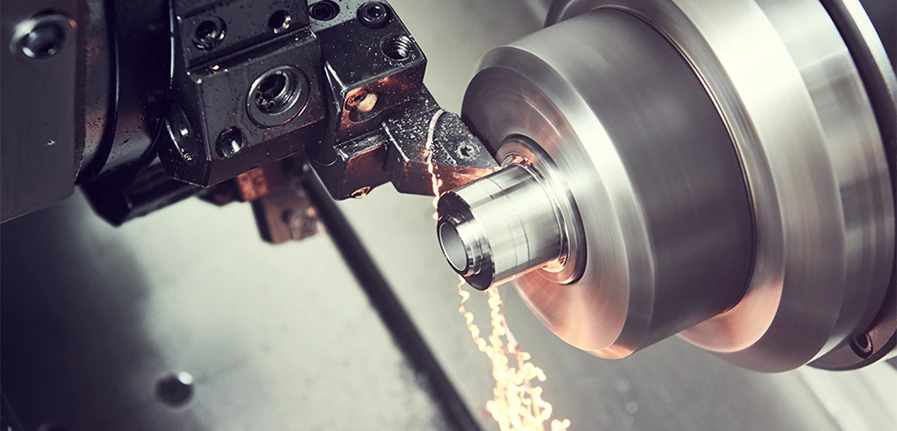
Turning is a subtractive machining process — also known as lathe machining — in which material is removed from a rotating workpiece by a cutting tool. The workpiece is clamped in a chuck and spun at high speed, while the cutting tool moves along and across it to shape the desired geometry. Because the part rotates around a single axis, turning is ideally suited to producing cylindrical and conical shapes with excellent dimensional accuracy and smooth surface finishes.
The key distinction between turning and milling lies in what moves. In turning, the workpiece rotates and the tool stays fixed; in milling, the workpiece is held stationary while a rotating cutter removes material. This makes turning the natural choice for round parts and milling the choice for prismatic parts with flat faces, pockets, and slots. Modern CNC lathes automate the entire process, delivering consistent, repeatable results without manual intervention.
Basic turning operations
Turning is not a single operation but a family of related cutting techniques performed on a lathe. Each shapes a different feature of the part.
| Operation | What it does | Typical use |
|---|---|---|
| External diameter turning | Removes material from the outer surface of the rotating workpiece | Shaping and finishing the outside profile of shafts and cylinders |
| Internal diameter turning (boring) | Cuts from the inside to enlarge or refine an existing hole | Precise bores, bushing seats, internal bearing surfaces |
| Facing | Cuts across the end face of the workpiece to create a flat surface | Squaring off ends, setting part length |
| Thread cutting | Uses a threading tool to cut helical threads | Producing both internal and external threads directly on the lathe |
| Drilling | Drills a hole along the rotational axis of the part | Creating axial holes, often followed by boring for accuracy |
One notable advantage of turning is its ability to cut both external and internal threads. This is more flexible than thread milling, which is typically limited to certain thread types. Because several of these operations can be performed in a single setup, turning is highly efficient for complex cylindrical parts.
What parts are made by turning
Turning is the go-to process for custom parts that are round or rotationally symmetric. Because meviy manufactures individually designed components from your own 3D CAD data — not catalogue or standard parts — the examples below refer to custom-engineered parts built to your specifications, not off-the-shelf hardware.
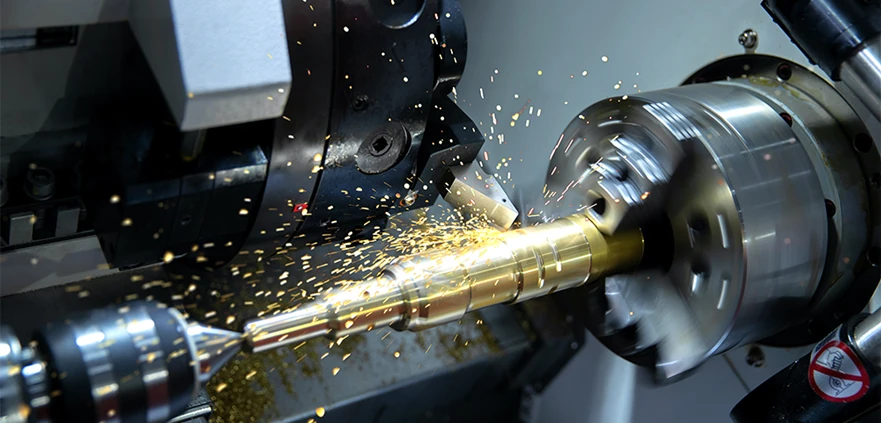
Typical custom turned parts include shafts and spindles, bushings and sleeves, spacers, custom bolts and pins, threaded adapters, flanges, couplings, and housings for bearings or sensors. Any part whose primary geometry is cylindrical, conical, or otherwise built around a central axis is a strong candidate for turning.
| Industry | Typical custom turned parts |
|---|---|
| Automotive | Drive shafts, custom bushings, adapters for test rigs and prototypes |
| Mechanical engineering | Spindles, spacers, couplings, custom fasteners for special machines |
| Medical technology | Precision housings, instrument components, sensor mounts |
| Robotics & automation | Joint components, shaft adapters, bearing seats |
| Electronics | Connector housings, standoffs, custom enclosures |
If your part is rotationally symmetric and designed specifically for your application, it can typically be manufactured with CNC turning. For parts that also require flat faces, pockets, or off-axis features, a combination of turning and CNC machining may be the better route.
Types of lathes
The type of lathe determines the level of automation and precision. For custom part manufacturing, two categories matter most.
Universal (manual) lathe
A universal lathe is operated by hand — the operator moves the tools and makes adjustments manually. This makes it flexible for one-off pieces, complex shapes that are difficult to program, and prototypes requiring fine manual adjustment. However, output quality depends heavily on operator skill, and the process is slow and hard to reproduce consistently.
NC and CNC lathes
Numerically controlled (NC) and computer-numerically-controlled (CNC) lathes execute programmed instructions automatically. Once the cutting conditions are set, the machine produces identical parts repeatedly with high precision — regardless of operator experience. CNC lathes are the standard for both prototyping and series production of custom turned parts, and they are the machines meviy uses to manufacture turned components.
Beyond these, specialised lathes exist for specific needs: facing lathes and vertical lathes handle large-diameter workpieces where chip removal and gravity-induced deflection are concerns, while bench lathes are compact machines for small parts. For most custom mechanical components, however, CNC turning covers the requirements.
| Feature | Universal (manual) lathe | CNC lathe |
|---|---|---|
| Control | Manual | Programmed (computer) |
| Precision | Operator-dependent | High, repeatable |
| Reproducibility | Low | Very high |
| Best suited for | One-offs, manual repairs | Prototypes and production of custom parts |
Advantages and disadvantages of turning
Turning offers distinct benefits for cylindrical parts, but it is not the right process for every geometry. The table below summarises the main trade-offs.
| Advantages | Disadvantages |
|---|---|
| High accuracy on round parts — rotating the workpiece around a single axis produces excellent concentricity and dimensional accuracy | Limited to rotational geometries — turning cannot easily produce flat faces, pockets, or off-axis features without additional processes |
| Excellent surface finish — continuous cutting along the rotation produces smooth cylindrical surfaces | Frequent tool changes — complex parts requiring several operations may need multiple tools, adding to cycle time |
| Versatile operations — external and internal turning, facing, threading, and drilling can be combined in one setup | Setup sensitivity — accurate clamping and alignment are critical, as misalignment directly degrades precision |
| Efficient for threads — both internal and external threads can be cut directly on the lathe | Not ideal for very short runs of complex shapes — where a combined milling/turning approach may be more economical |
Frequently asked questions
What is the difference between turning and milling?
The core difference is what moves. In turning, the workpiece rotates and the cutting tool stays fixed, which makes it ideal for round, rotationally symmetric parts like shafts and bushings. In milling, the workpiece is held stationary while a rotating cutter removes material, which suits prismatic parts with flat surfaces, pockets, and slots. Many complex parts are produced using both processes in combination.
What shapes can be made by turning?
Turning produces rotationally symmetric shapes: cylinders, cones, tapers, grooves, threads, and stepped diameters. It is well suited to shafts, bushings, spacers, pins, and similar parts built around a central axis. Features that are not rotationally symmetric — such as flat faces at arbitrary angles or off-axis holes — usually require additional milling operations.
What is the difference between an NC lathe and a CNC lathe?
Both are numerically controlled, and the terms are often used interchangeably. NC (Numerical Control) refers to the original technology where machines followed programmed instructions from punched tape or similar media. CNC (Computer Numerical Control) is the modern evolution, where a computer stores and executes the program, allowing easier programming, editing, and integration with CAD/CAM. In practice today, virtually all automated lathes are CNC machines.
Can threads be cut using turning?
Yes. Thread cutting is one of the standard turning operations. Using a dedicated threading tool, a lathe can cut both external threads (on the outside of a part) and internal threads (inside a bore). This is one of the advantages of turning over some other processes, which are often limited to specific thread types.