



Moulding processes shape material with a mould or die — and they produce a large share of the metal and plastic parts around us, from crankshafts and engine blocks to car body panels and plastic housings. This guide explains how the main moulding processes work, how an injection mould is built, and when a mould pays off compared with machining.
We cover forging, casting, pressing and injection moulding, compare them side by side, and look at what matters when moulds are designed and made.
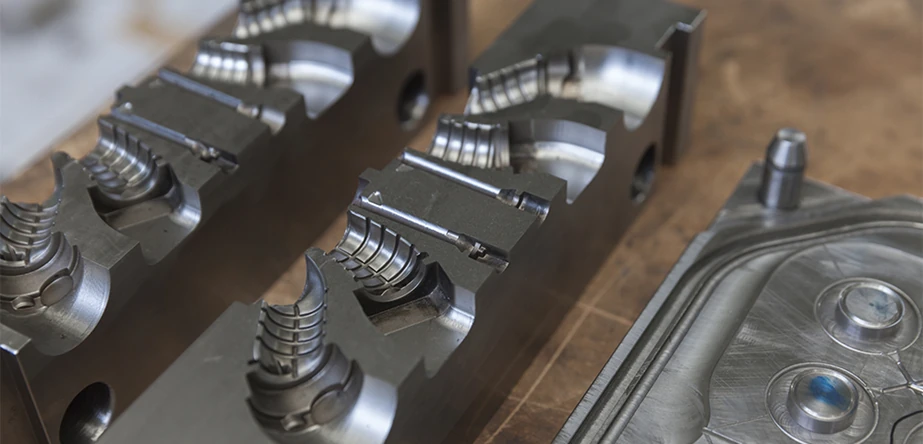
What is moulding?
Moulding is a group of manufacturing processes that use a mould — usually made of metal or sand — to give a material its shape. Depending on the process, the material is compressed inside the mould, or it is heated until liquid and poured or injected into it. The right method depends on the material and on the shape of the product.
In English, the tool has two names: in casting and injection moulding, it is called a mould; in forging and pressing, where solid metal is formed under pressure, it is usually called a die. The principle is the same — the shape of the tool defines the shape of the part.
Advantages and disadvantages of moulding
The defining feature of moulding is the mould itself. Parts must be designed so that they can be removed from it easily. Side holes, undercuts and hollow shapes are possible, but they require additional mould elements or special techniques.
Advantages
- Ideal for mass production: moulding produces large quantities of identical parts with consistent quality.
- Complex shapes: moulding is very good at forming intricate curves and freeform surfaces, such as fan blades or car body panels.
- Low cost per part: once the mould exists, each additional part is fast and inexpensive to produce.
Disadvantages
- High initial cost and lead time: making a mould, especially a metal one, takes considerable time and investment, which makes moulding unsuitable for small quantities.
- Limited flexibility: once the mould is made, design changes are difficult and expensive.
- Shape constraints: parts must be releasable from the mould, which limits certain geometries or requires more complex tooling.
Types of moulding processes at a glance
| Process | Material | Material state | Tool | Typical parts |
|---|---|---|---|---|
| Forging | Steel, aluminium alloys | Solid, hot or cold | Die | Crankshafts, connecting rods, hand tools |
| Casting | Cast iron, aluminium | Liquid (molten) | Mould (metal, sand or plaster) | Engine blocks, housings, wheel rims |
| Pressing | Steel and aluminium sheet | Solid sheet, room temperature | Die | Body panels, doors, appliance parts |
| Injection moulding | Plastics, some rubbers | Molten | Mould (tool steel or aluminium) | Housings, containers, toys, dishes |
Forging
Forging shapes metal by hammering or pressing it. Traditionally, the material is heated until red-hot and shaped with a hammer; in industrial production, it is formed in dies mounted in forging hammers or presses.
Forging uses the plasticity of metals such as steel and aluminium alloys. A metal billet is struck or pressed with great force, which deforms it plastically into the desired shape. There are two main types:
- Hot forging: the material is heated to around 1,100–1,250 °C for iron-based materials and around 400 °C for aluminium alloys.
- Cold forging: the material is formed at room temperature, although it heats up during deformation.
The key benefit of forging is that it refines the internal structure of the metal: the grain structure follows the shape of the part, which increases strength. That is why forging is used for components that must withstand high loads.
Applications of forging
- Automotive parts: crankshafts, connecting rods and other highly loaded components
- Aerospace parts: turbine components and landing gear
- Power plant components: turbine main shafts
- Tools: knives, pliers and other hand tools
Casting
Casting is one of the oldest metalworking techniques. Molten metal — such as iron or aluminium — is poured into a mould, where it cools and solidifies into the desired shape.
Moulds can be made of metal, sand or plaster. Casting makes it easier than forging to produce complex shapes, including internal cavities. Metal moulds are expensive but suited to high volumes, while sand and plaster moulds are more affordable and suitable for one-off parts and small batches. On the downside, casting requires extensive melting and handling equipment, and the parts can contain internal voids known as porosity. Cast iron is also relatively brittle compared with forged steel because of its higher carbon content.
Applications of casting
- Automotive parts: engine blocks, transmission housings and wheel rims
- Electronics: housings for computers and cameras
- Household items: kettles, frying pans and manhole covers
Pressing
Pressing shapes material by forcing it into a die under pressure. It is mainly used for thin metal sheet, but also for other materials such as paper and plastic.
In pressing, thin metal sheets — for example cold rolled steel sheet such as SPCC, explained in our article on hot vs. cold rolled steel — are pressed into a die and deformed plastically. Unlike forging, which works with bulky material, pressing requires less force and is usually carried out at room temperature. Steel and aluminium alloys are the most common materials.
Pressing is closely related to sheet metal fabrication. Both form thin sheet, but pressing uses dedicated dies and pays off for large series of identical parts such as car body panels. For prototypes and small batches, sheet metal parts are more economical to produce without dedicated tooling — by laser cutting and bending.
Applications of pressing
- Aerospace parts: outer skin panels of aircraft
- Automotive parts: body panels and doors
- Electrical appliances: washing machine drums and light fixtures
- Everyday items: spoons, coins and similar products
Injection moulding
Injection moulding is the most important process for shaping plastics, and it is also used for some rubber materials. The raw material, usually in pellet form, is melted and injected under pressure into a mould, where it cools and solidifies. Additives and colourants can be mixed in to give the part the required properties. Typical materials range from commodity plastics to engineering plastics and transparent plastics.
An injection moulding cycle runs in four steps:
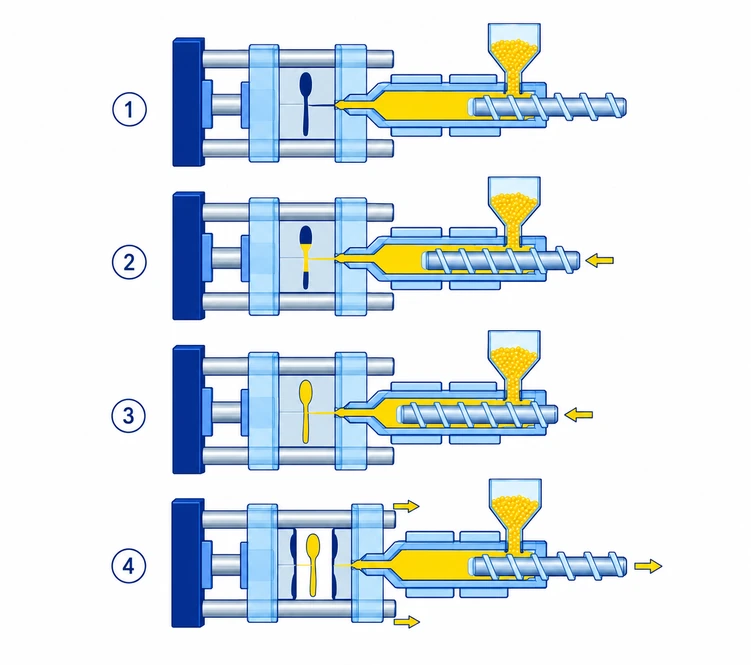
- Clamping: the two halves of the mould close and are held together under high force.
- Injection: the screw pushes the molten plastic through the nozzle into the mould.
- Holding and cooling: pressure is maintained while the plastic cools and solidifies; at the same time, the screw prepares the material for the next shot.
- Opening and ejection: the mould opens and the finished part is ejected.
Injection moulding is similar to casting in that a liquid material is filled into a mould, but the materials differ. It also allows special processes such as two-shot moulding, where two different plastics are combined in one part, and insert moulding, where metal components are placed in the mould before injection.
Applications of injection moulding
- Household items: dishes, stationery and similar products
- Containers: bottles and caps for detergents and beverages
- Toys: housings and internal components
- Electronics: housings and decorative parts
How an injection mould works
An injection mould consists of two main halves. The fixed half on the injection side usually carries the cavity, which forms the outer shape of the part. The moving half carries the core, which forms the inner shape, together with the ejector system that pushes the finished part out once it has cooled.
| Mould component | Function |
|---|---|
| Cavity | Forms the outer shape of the part; usually in the fixed half |
| Core | Forms the inner shape of the part; usually in the moving half |
| Sprue, runner and gate | Guide the molten plastic from the nozzle into the cavity |
| Cooling channels | Regulate the mould temperature for uniform solidification |
| Ejector pins | Push the finished part out of the mould |
| Slides and lifters | Form undercuts and side features, then retract for ejection |
| Guide pins | Align both halves of the mould precisely |
Cooling channels are placed so that the plastic solidifies evenly and defects are minimised. Sprue, runners and gates are designed to fill the cavity efficiently with as little waste as possible. More advanced moulds use slides and lifters to form complex geometries and undercuts that a simple two-part mould cannot produce: these elements move in sync with the opening and closing of the mould and retract so that the part can be ejected smoothly.
The design and structure of the mould determine the efficiency of production and the quality of the parts — and ensure that every part meets its specification with high repeatability.
How moulds are made
Mould making is a precise, multi-stage process. First, the mould is designed in CAD so that it will produce parts that meet the required specifications. The design is converted into CNC programs that control the machining of the mould components from metal blocks — typically aluminium or alloy steels such as pre-hardened steel or stainless steel.
Cavities and cores are produced by high-precision milling, drilling and electrical discharge machining (EDM). EDM is needed wherever sharp inside corners are required, which a rotating end mill cannot produce — see our guide to the corner radius. The machined components are then polished and assembled, and cooling channels, ejector pins and guide pins are added. Hardened steels, which require heat treatment, offer the longest service life. Finally, the mould is tested and fine-tuned until it produces accurate, high-quality parts.
Key considerations for mould design
- Design precision: any inaccuracy in the mould is transferred to every part. Pay particular attention to the alignment of cavity and core and to the position of gates and runners for an even material flow.
- Mould material: the choice of material affects the durability of the mould and the quality of the parts; hardened steel is often preferred for its long service life.
- Temperature control: uneven cooling can cause warping or incomplete filling.
- Material properties: knowing the shrinkage and viscosity of the plastic helps you adjust the mould design and process parameters for the required precision and finish.
- Maintenance: regular inspection and maintenance prevent wear that would affect production.
Machined parts from meviy — without a mould
meviy does not make moulded parts — it manufactures individually designed custom parts from your own 3D CAD data, without any tooling. That makes meviy a fast alternative wherever a mould does not pay off yet, and a supplier for mould makers themselves:
- Prototypes and small batches without mould costs: metal and plastic parts made directly from your 3D model by CNC machining
- Mould plates, inserts and fixture parts made by CNC milling — for example in the pre-hardened steels NAK55 equiv. and EN 1.1206 equiv. (20-27 HRC), or in EN AW-7075 equiv. for prototype moulds
- Guide pins, bushings and other round mould components made by CNC turning
- Sheet metal parts in small and medium quantities through sheet metal fabrication — no press dies required
- Instant price and lead time — no 2D drawing required
Frequently asked questions about moulding
What is the difference between a mould and a die?
Both are tools that give a part its shape. "Mould" is used for processes in which liquid or molten material fills the tool, such as casting and injection moulding. "Die" is used for processes in which solid metal is formed under pressure, such as forging and pressing.
What is the difference between cavity and core?
The cavity forms the outer shape of the part and is usually located in the fixed half of the mould. The core forms the inner shape and is usually located in the moving half, together with the ejector pins.
Why are injection moulds so expensive?
Moulds are complex, precision-machined tools made of hard tool steel, with cooling channels, ejectors and often slides. Designing, machining, polishing and testing them takes a lot of time. This cost is only spread efficiently over large quantities.
When is a mould worthwhile, and when is CNC machining better?
There is no fixed threshold — it depends on the part, the material and the mould cost. As a rule, moulding pays off for large series of identical parts. For prototypes, small batches and designs that are still changing, CNC machining or sheet metal fabrication without tooling is usually faster and cheaper.
Choosing the right process
Forging, casting, pressing and injection moulding all use a mould or die to shape material, and they are ideal for mass-producing identical, high-quality parts. The high initial cost and lead time of the mould, however, make them less suitable for small quantities and frequent design changes. Understanding these processes — and how a mould works — helps you choose the right manufacturing method for your material, quantity and requirements.