


EN 1.4401 equiv. (SUS316) — known internationally as 316 stainless steel — is the go-to grade when parts have to withstand chlorides, seawater or salty air. Thanks to its molybdenum content, it offers clearly better corrosion resistance than the widely used EN 1.4301 equiv. (SUS304).
Stainless steel is used across industrial products, from plant piping to construction materials and components for industrial machinery. It is divided into three families: austenitic, ferritic and martensitic. This article explains what EN 1.4401 equiv. is, which properties, advantages and disadvantages it has, where it is used, and how it compares with other stainless grades.
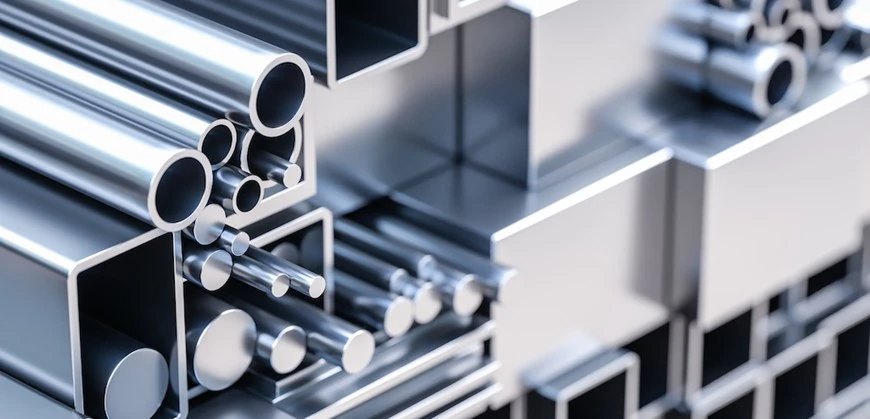
What is EN 1.4401 equiv. (SUS316)?
EN 1.4401 equiv. — also designated AISI 316 or JIS SUS316 — belongs to the austenitic stainless steel family, like EN 1.4301 equiv. It contains around 17 % chromium, 10–13 % nickel and 2–2.5 % molybdenum, and it is non-magnetic in the annealed condition.
Like all stainless steels, it resists corrosion by forming a passive film on its surface. This thin chromium oxide layer acts as a protective cover and prevents the iron from oxidising. The film forms once the chromium content exceeds about 10.5 %. If it is damaged, it reforms almost immediately, so the material keeps its corrosion resistance and has very little tendency to rust.
What sets EN 1.4401 equiv. apart is molybdenum. Molybdenum strengthens the passive film — in terms of resistance to pitting corrosion, it is roughly three times as effective as chromium. As a result, 316 stainless steel resists pitting and crevice corrosion much better than EN 1.4301 equiv. and is suitable for areas exposed to seawater. Because it is less common than EN 1.4301 equiv., availability can be more limited.
Properties at a glance
| Property | EN 1.4401 equiv. (SUS316) |
|---|---|
| Steel family | Austenitic stainless steel |
| Chromium (Cr) | 16.5–18.5 % |
| Nickel (Ni) | 10–13 % |
| Molybdenum (Mo) | 2–2.5 % |
| Magnetism | Non-magnetic when annealed; slight magnetism possible after processing |
| Corrosion resistance | Very good, including chloride environments such as seawater |
| Weldability | Very good |
| Machinability | Lower than EN 1.4301 equiv.; low thermal conductivity |
| Cost and availability | Higher cost, less widely stocked than EN 1.4301 equiv. |
Advantages and disadvantages of 316 stainless steel
Advantages
- Excellent corrosion resistance, even in harsh chloride environments such as seawater
- Good toughness and formability
- Excellent weldability
- Non-magnetic in the annealed condition — suitable near precision instruments that work with magnetic fields, such as MRI machines
Disadvantages
- Higher cost and lower availability than EN 1.4301 equiv.
- No advantage over EN 1.4301 equiv. in strongly oxidising acids such as nitric acid
- Like other austenitic grades, susceptible to chloride stress corrosion cracking in warm, chloride-containing environments
- Can become partially magnetic if processing changes its internal crystal structure; removing this requires solution annealing with rapid cooling, which adds effort and cost
- Reduced machinability due to molybdenum and low thermal conductivity
Machining tips for EN 1.4401 equiv.
Molybdenum reduces machinability, and the low thermal conductivity of EN 1.4401 equiv. means heat stays at the cutting edge instead of dissipating through the part. Keep these points in mind:
- Cool the tool consistently during cutting to keep tool temperatures under control.
- Reduce the cutting speed to prevent temperature rise at the cutting edge.
- Keep a constant feed and avoid letting the tool rub — austenitic stainless steel work-hardens quickly at the surface.
With meviy, these parameters are handled in production: EN 1.4401 equiv. is available for CNC milling and CNC turning, so you only need to upload your 3D model and select the material.
Applications of 316 stainless steel
- Pumps and piping for chlorine-containing liquids such as seawater: coastal plant facilities, plus piping, valves and pumps in factories that use seawater.
- Marine components: ships are in constant contact with seawater, so EN 1.4401 equiv. is used in large vessels such as chemical tankers.
- Architectural components in coastal areas: external wall panels and other components exposed to corrosive sea breezes.
- Piping in regions where de-icing agents are used: de-icing salts based on sodium chloride or calcium chloride are about as corrosive as seawater.
- Commercial food storage containers: condiments usually contain salt, so a highly corrosion-resistant grade is required.
EN 1.4401 vs. EN 1.4301 vs. EN 1.4016
The table compares 316 stainless steel with the two other common stainless grades. Details on each comparison follow below.
| Property | EN 1.4401 equiv. (SUS316) | EN 1.4301 equiv. (SUS304) | EN 1.4016 equiv. (SUS430) |
|---|---|---|---|
| Steel family | Austenitic | Austenitic | Ferritic |
| Main alloying elements | Chromium, nickel, molybdenum | Chromium, nickel | Chromium (no nickel) |
| Magnetic | No | No | Yes |
| Corrosion resistance in chlorides | Very good | Limited | Lower |
| Strength and ductility | Similar to EN 1.4301 equiv. | Similar to EN 1.4401 equiv. | Lower tensile strength, less ductile |
| Heat distortion when welding | Higher | Higher | Lower |
| Cost | Higher | Moderate, widely available | Lower |
| Best suited for | Seawater and chloride exposure | General use without chloride exposure | Cost-sensitive parts in mild environments |
Difference from EN 1.4301 equiv. (SUS304)
Mechanical properties such as tensile strength are very similar for EN 1.4301 equiv. and EN 1.4401 equiv. The differences lie in corrosion resistance, cost and workability. EN 1.4301 equiv. contains about 18 % chromium and 8 % nickel but no molybdenum. It is less resistant to chlorides and therefore less suitable for areas exposed to seawater, whereas EN 1.4401 equiv. performs well under sea breeze and seawater. With its lower nickel content, EN 1.4301 equiv. is more cost-effective and widely available, and it generally offers better machinability than EN 1.4401 equiv.
Difference from EN 1.4016 equiv. (SUS430)
EN 1.4016 equiv. is a typical ferritic stainless steel: it contains chromium but no nickel. It is magnetic and generally more affordable than EN 1.4401 equiv., but more susceptible to corrosion than both EN 1.4401 equiv. and EN 1.4301 equiv. It also has lower tensile strength and is less ductile. On the plus side, its lower coefficient of thermal expansion means less heat distortion during welding. However, its strength drops in high-temperature environments above 500 °C, so check the operating conditions carefully.
What parts can you order in EN 1.4401 equiv. from meviy?
meviy manufactures individually designed custom parts in EN 1.4401 equiv. from your own 3D CAD data — not standard or catalogue parts. Through CNC machining, you get components for wet, salty or chemically demanding environments, exactly as you designed them.
- Milled parts such as plates, blocks, flanges and housings
- Turned parts such as shafts, bushings and fittings
- Instant price and lead time directly from your 3D model — no 2D drawing required
- Design changes re-quoted in real time
Frequently asked questions about 316 stainless steel
Is 316 stainless steel magnetic?
In the annealed condition, EN 1.4401 equiv. (SUS316) is non-magnetic. Processing that changes its internal crystal structure can make some areas slightly magnetic. Solution annealing followed by rapid cooling removes this magnetism again.
What is the difference between 316 and 304 stainless steel?
Both are austenitic grades with similar mechanical properties. 316 contains 2–2.5 % molybdenum, which gives it much better resistance to pitting and crevice corrosion in chloride environments. 304 is more affordable, more widely available and easier to machine.
Is EN 1.4401 the same as SUS316 and AISI 316?
They are the corresponding designations in the European (EN), Japanese (JIS) and American (AISI) standards. Their compositions are closely comparable but not identical in every detail — which is why meviy lists the material as "EN 1.4401 equiv."
Is 316 stainless steel suitable for seawater?
Yes. Among the standard austenitic grades, 316 is the common choice for seawater, splash zones and coastal environments. In warm, stagnant seawater or tight crevices, localised corrosion can still occur, so check the specific operating conditions.
Is EN 1.4401 equiv. the right choice for your part?
The defining characteristic of EN 1.4401 equiv. (SUS316) is its corrosion resistance. Combined with being non-magnetic, it is suitable for situations where ordinary steel is difficult to use. When you design parts that come into contact with seawater or chlorides, it is usually the best choice. Because it costs more than other stainless grades, select the material based on the intended use and the operating environment.