


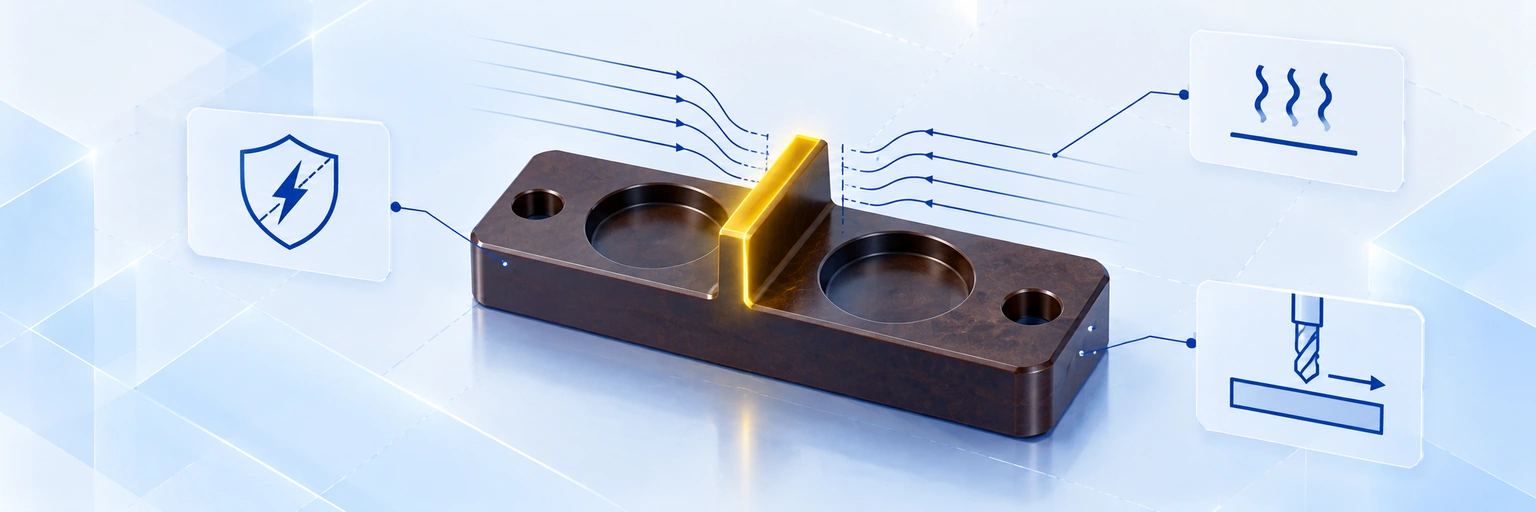
Thermoset plastics are produced in much smaller quantities than thermoplastics and are often seen as the supporting actors of the plastics world. Yet the very first fully synthetic plastic made by humans was not a thermoplastic but a thermoset – and its name is Bakelite.
In this article, we look at what Bakelite is, which types are available, what its advantages and disadvantages are and where it is used today. Bakelite offers a well-balanced set of properties and is mostly supplied as laminated sheets, in which the plastic is combined with a base material such as paper or cotton fabric. From electrical engineering to cutting-edge materials, it quietly supports many areas of our everyday lives.
What is Bakelite?
Bakelite, also known as phenolic resin or phenol-formaldehyde, is a thermoset plastic made from phenol and formaldehyde. The reaction between the two substances was first described in 1872 by the German chemist Adolf von Baeyer. The Belgian-American chemist Leo Baekeland turned it into a usable material in 1907, and Bakelite is named after him.
To produce Bakelite, phenol and formaldehyde are heated with an acid or alkaline catalyst, and curing agents are added as needed. The result is a three-dimensional, cross-linked network. Unlike thermoplastics, a cured thermoset cannot be melted again – it keeps its shape when heated.
In industry, Bakelite is best known as a heat-cured sheet material in which paper or fabric is impregnated with the plastic. It is also used in adhesives, coatings and electrical insulation. Thanks to its low cost, good heat resistance, strength and electrical insulation, Bakelite has been used in a wide range of applications for more than a century. Although thermoplastics have taken over many of its former uses, Bakelite continues to find new markets, and its use is expected to grow further.
Paper vs cotton Bakelite: the two main types
Today, Bakelite is rarely sold as a pure plastic. It is usually supplied as laminated sheets, which are made by impregnating layers of a base material with the plastic and curing them under heat and pressure. Sheets with paper as the base material are called paper Bakelite (paper phenolic laminate, PF CP according to EN 60893). Sheets with cotton fabric are called cotton or cloth Bakelite (cotton phenolic laminate, PF CC).
| Property | Paper Bakelite | Cotton Bakelite |
|---|---|---|
| Base material | Layers of paper | Layers of cotton fabric |
| Cost | Lower | Higher |
| Weight | Lighter | Heavier |
| Mechanical strength | Good | Higher, more impact resistant |
| Electrical insulation | Very good – preferred choice | Good |
| Moisture absorption | High | Lower than paper, but still noticeable |
| Typical use | Insulating plates, terminal boards, spacers | Mechanically loaded parts, wear and guide parts |
| Available at meviy | Bakelite (paper, natural colour), Bakelite (paper, black) | Bakelite (cotton, natural) |
As a rule of thumb: choose paper Bakelite when electrical insulation and cost are the priority, and cotton Bakelite when the part has to withstand mechanical loads or impacts. Both types should be used in dry environments.
Advantages of Bakelite
Bakelite has numerous advantages. The most important ones are:
- High heat resistance: as a thermoset, Bakelite does not melt. It remains dimensionally stable and keeps its strength at temperatures at which many thermoplastics already soften.
- Excellent electrical insulation: its insulating properties make Bakelite a proven material for printed circuit boards, circuit breakers and parts in distribution boards.
- High mechanical strength: Bakelite is rigid and strong. Cotton Bakelite in particular is used where impact resistance is required.
- Good processability: laminated sheets can be machined precisely, for example by CNC milling. As a moulding compound, Bakelite can also be injection moulded: the material is moderately heated in the barrel, injected into a hot mould and cured there at around 150–180 °C.
Disadvantages of Bakelite
When working with Bakelite, keep the following drawbacks in mind:
- Moisture absorption: because the laminates contain paper or cotton, they absorb water. Bakelite is therefore not suitable for parts in contact with water or in very humid environments.
- Low weather and chemical resistance: Bakelite is sensitive to UV radiation, so it should not be used outdoors without protection. It is also attacked by strong alkalis.
- Limited recyclability: as a cured thermoset, Bakelite cannot be melted down and reprocessed like thermoplastics.
Where is Bakelite used?
Since industrial production began in 1907, Bakelite has been used in many everyday products such as tableware, kitchen utensils, buttons, watches, telephones and accessories. With the invention of many thermoplastics such as nylon and fluoroplastics, many of these applications gradually switched to other materials. Moulded consumer products made of Bakelite have become rare, but its properties still make it the right choice for many technical applications.
Thanks to its excellent electrical insulation, Bakelite is used in printed circuit boards, distribution boards and circuit breakers – and therefore in practically every field that relies on electricity. It also serves as a binder in adhesives, moulding sand for metal casting, paints and binders for 3D printing. Because phenolic plastics dissolve in alkaline developers and absorb ultraviolet light, they are also used in photoresists for chip manufacturing. Other applications include high-performance materials, such as hard carbon for the negative electrodes of lithium-ion batteries. In 2010, the heat shield of the Hayabusa capsule, which returned samples from the asteroid Itokawa to Earth, was made of a carbon-fibre-reinforced phenolic composite.
What parts are made from Bakelite?
In mechanical engineering, Bakelite laminates are used wherever insulating, rigid and lightweight plastic parts are needed. These are typically individually designed parts, not standard or catalogue parts – exactly the kind of part meviy manufactures from your own 3D CAD data.
- Insulating plates and spacers for electrical cabinets and switchgear
- Terminal and component carriers for electrical assemblies
- Base plates and nests for test equipment, jigs and fixtures
- Guide and wear parts made of cotton Bakelite
With meviy, you can order Bakelite parts produced by CNC milling in three variants: paper (natural colour), paper (black) and cotton (natural). Upload your 3D model, select the material and get the price and delivery date instantly – no 2D drawing required. You can find an overview of all available materials on our CNC machining page.
Frequently asked questions about Bakelite
Is Bakelite a plastic?
Yes. Bakelite is a thermoset plastic made from phenol and formaldehyde, also known as phenolic resin. It was the first fully synthetic plastic and, unlike thermoplastics, cannot be melted again once cured.
Is Bakelite still used today?
Yes. While Bakelite has largely disappeared from consumer products, it is still widely used in industry – for example in printed circuit boards, electrical insulation, casting binders, adhesives, photoresists and as machined laminate parts.
What is the difference between paper and cotton Bakelite?
Paper Bakelite is cheaper and lighter and is the preferred choice for electrical insulation. Cotton Bakelite is reinforced with cotton fabric, which gives it higher mechanical strength and impact resistance, and it absorbs less moisture than paper Bakelite.
Can Bakelite be machined?
Yes. Bakelite laminate sheets can be machined precisely by CNC milling, drilling and sawing. With meviy, you can order milled Bakelite parts in paper and cotton grades directly from your 3D CAD data.
Conclusion
Bakelite is the world’s first fully synthetic plastic and has been in use for more than a century. As a thermoset, it offers a well-balanced combination of low cost, heat resistance, strength and electrical insulation. Today, it is mainly available as laminated sheets with paper or cotton fabric as the base material. Its drawbacks are moisture absorption, sensitivity to UV radiation and alkalis, and limited recyclability. Bakelite is widely used in printed circuit boards, distribution boards, adhesives, paints, photoresists and negative electrodes for lithium-ion batteries – and new applications continue to emerge.