


Polyethylene terephthalate (PET) is best known as the plastic used for drinks bottles. It is a versatile, transparent plastic that is widely used in everyday life and in industry. This article explains what PET is, where it is used, what its strengths and weaknesses are, and how it differs from similar plastics such as PE, PVC and PP.
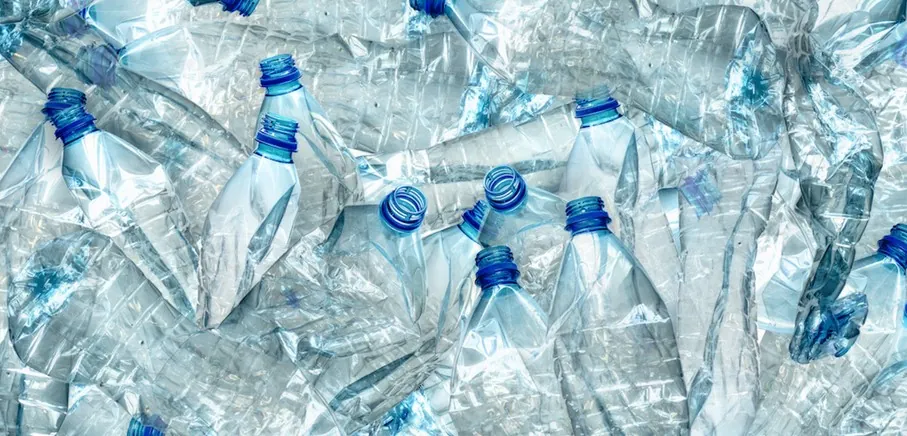
What is PET?
PET is a thermoplastic polyester made by combining terephthalic acid and ethylene glycol. It is one of the most widely used plastics in the world and appears in drinks bottles, clothing fibres, food trays, industrial films, magnetic tapes and many other products.
PET was patented in the United Kingdom in 1941 and was first sold as a polyester. Today it is marketed under different trade names in different regions: "Dacron" (DuPont) in the United States, "Terylene" in the United Kingdom and "Tetoron" (Teijin and Toray) in Japan.
Properties of PET
PET combines good mechanical strength with low water absorption and good electrical insulation. Typical properties at a glance:
| Property | PET |
|---|---|
| Type | Thermoplastic polyester (semi-crystalline) |
| Density | approx. 1.38 g/cm³ |
| Glass transition temperature | approx. 70–80 °C |
| Melting point | approx. 250–260 °C |
| Transparency | High (amorphous grades); crystalline and reinforced grades are opaque |
| Water absorption | Low |
| Chemical resistance | Good against many chemicals; attacked by strong acids and alkalis |
| Electrical insulation | Good |
| Recyclability | Very good |
Values vary with the grade, so always check the data sheet of the manufacturer for your application.
Main applications of PET
PET is used in a wide range of products, and the grade differs depending on the application:
- Food and drink packaging: bottles, trays, egg boxes and other containers. PET is popular here because it is highly transparent, easy to mould, lightweight and shatter-resistant, which gave it clear advantages over glass. PET containers are also easy to recycle.
- Synthetic fibre: as polyester, PET is the most widely used synthetic fibre. It is soft, retains heat well and dries quickly, so it is used in fleeces, sweaters and shirts as well as in curtains, carpets, ropes, tents and outdoor sheeting.
- Engineering plastic: PET for industrial use is found in films, magnetic tapes, electronic components, housings for electrical products, partitions and displays. It is also available as plates and rods for machined parts.
- Glass-fibre-reinforced PET (GF-PET): adding glass fibres makes PET stiffer, stronger and more dimensionally stable. This lightweight, durable material is used in automotive components, among other things.
Advantages of PET
- Good low-temperature performance: PET stays usable at low temperatures.
- Transparency: high clarity, ideal where the contents or the part must be visible, for example food containers and films.
- Water resistance: low water absorption means PET hardly deforms with moisture and is suitable for liquid containers.
- Electrical insulation: good insulating properties, better than many general-purpose plastics.
- Recyclability: PET is easy to recycle, so its environmental impact is relatively low.
Disadvantages of PET
- Limited impact resistance: when PET is used as an engineering plastic, reinforced grades, often with glass fibres, are common.
- Hydrolysis: at high temperatures and in alkaline environments, PET degrades through hydrolysis.
- Sensitivity to strong acids and alkalis: dilute acids and many chemicals are tolerated, but strong acids and alkalis attack PET.
- Limited heat resistance for packaging: above its glass transition temperature, PET softens. Standard PET bottles start to deform at roughly 60–70 °C.
PET compared with PE, PVC and PP
PET is often compared with three other common plastics:
- PE (polyethylene): also known for chemical resistance and electrical insulation, and used for containers and plastic bags. It is softer and more easily damaged than PET and less transparent.
- PVC (polyvinyl chloride): well balanced in chemical resistance, electrical insulation, flame resistance and weathering resistance. It is less heat resistant than PET: PVC softens at around 70–80 °C. Its transparency is also lower than that of PET.
- PP (polypropylene): cheaper than PET and more resistant to chemicals and moisture, but less stiff. It is more vulnerable to impact at low temperatures and degrades under UV exposure unless it is stabilised.
| Property | PET | PE | PVC | PP |
|---|---|---|---|---|
| Transparency | High | Low | Medium | Medium (translucent) |
| Heat resistance | Good | Low | Low | Moderate |
| Chemical resistance | Good | Very good | Good | Very good |
| Impact resistance | Moderate | High | Moderate | Good (brittle in the cold) |
| Material price | Medium | Low | Low | Low |
| Available at meviy | Sheet metal fabrication, CNC milling | CNC milling, CNC turning (UHMWPE) | Sheet metal fabrication, CNC turning | CNC turning |
If you mainly need a transparent plastic, our guide to transparent plastics compares the options in more detail.
What parts are made from PET?
With meviy you can order custom parts designed individually and made from your own 3D CAD data – not standard or catalogue parts. PET is available in two ways: as plastic sheet for sheet metal fabrication, in transparent and smoke-brown, in thicknesses from 3 to 8 mm, and as glass-fibre-reinforced PET (brown) for CNC milling. Just upload your 3D model, select the material and get the price and delivery date instantly – no 2D drawing needed.
If your application needs a different plastic, meviy also offers POM, MC Nylon, PC, acrylic, PEEK and more, for example for CNC turning.
Frequently asked questions about PET
Is PET an engineering plastic?
PET used for industrial applications is classed as an engineering plastic. For machined parts it is often used in glass-fibre-reinforced form, which improves strength, stiffness and dimensional stability.
How heat resistant is PET?
PET melts at around 250–260 °C, but it starts to soften above its glass transition temperature of roughly 70–80 °C. Standard PET bottles therefore deform at around 60–70 °C, while crystalline and glass-fibre-reinforced grades can be used at considerably higher temperatures.
Which PET parts can I order with meviy?
You can order PET as plastic sheet parts through sheet metal fabrication (transparent or smoke-brown) and as glass-fibre-reinforced PET (brown) through CNC milling. Upload your 3D CAD model to see price and delivery date.
Is PET recyclable?
Yes. PET is one of the most widely recycled plastics, which is one reason for its low environmental impact in packaging.
Conclusion
PET is a transparent, lightweight and recyclable plastic that is made from terephthalic acid and ethylene glycol. It is used in bottles, polyester fibres, films, electronic components and, in reinforced form, in automotive parts. It offers good heat, cold and chemical resistance and good electrical insulation, but its impact resistance is limited, it degrades by hydrolysis in hot or alkaline environments and standard grades soften at relatively low temperatures. Similar plastics are PE, PVC and PP. With meviy you can get instant quotes for custom parts in PET.