


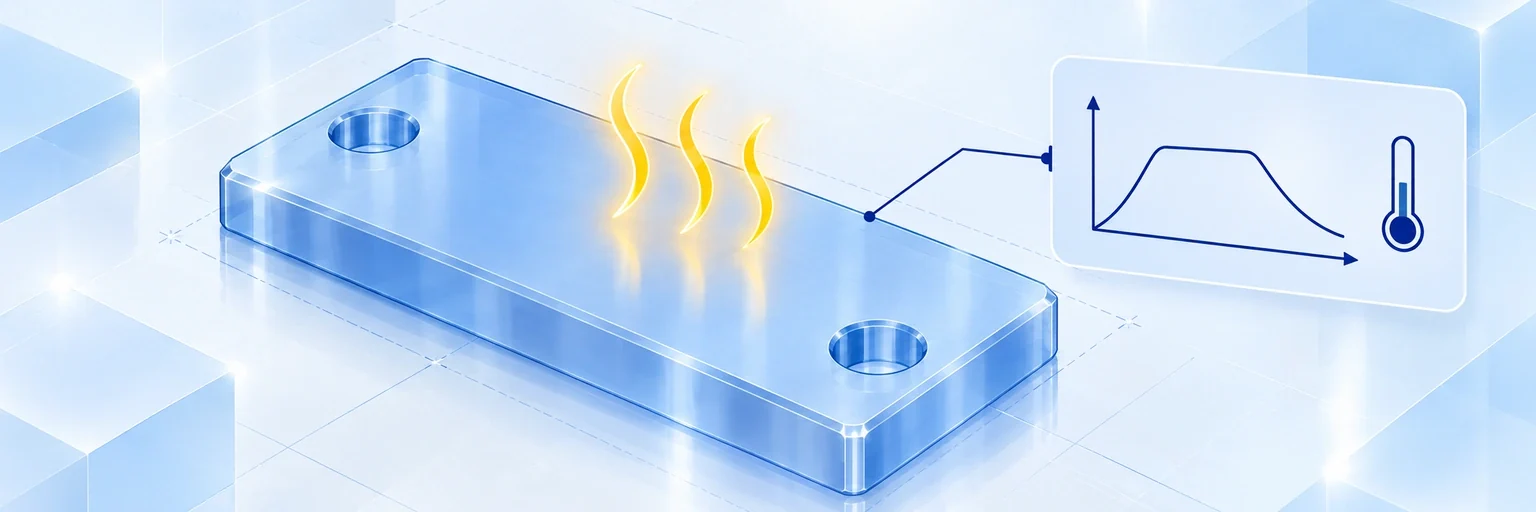
Heat treatment of steel lets you give a component exactly the properties it needs — a hard, wear-resistant surface, a tough core, or a soft and stress-free structure that is easy to machine. Choosing the right process is key for parts that slide against other components or have to withstand impact.
When the inherent properties of a material are not sufficient, heat treatment is the solution. But with so many processes available, selecting the right combination of material and heat treatment can be challenging. This guide covers the heat treatments most commonly used for machine components and the key points to consider when you design heat-treated parts.
What is heat treatment?
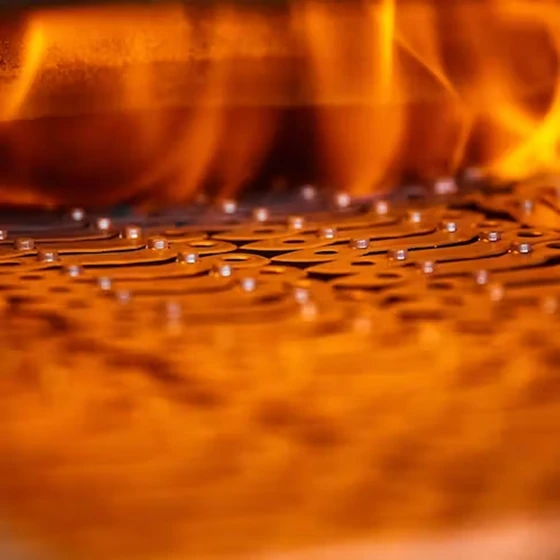
Heat treatment subjects components to controlled heating and cooling to change their structure — either throughout the entire part or only at the surface. Especially with carbon-containing steels, it can significantly change properties such as hardness, wear resistance and toughness.
Heat treatments fall into two groups. Bulk heat treatment treats the entire component and includes quenching and tempering, annealing and normalizing. Surface heat treatment targets mainly the surface layer and includes induction hardening, carburizing and nitriding.
The result depends on the heating temperature, the cooling rate and the cooling medium. Rapid cooling, as in quenching, increases hardness but also brittleness. Slower cooling, as in annealing and normalizing, refines and relaxes the structure of the material. Common cooling methods are water quenching, oil quenching, air cooling and furnace cooling.
How steel responds also depends on its carbon content. Steel with about 0.8 % carbon is called eutectoid steel; steels below this value are hypoeutectoid, steels above it hypereutectoid. Each group has different transformation temperatures, which determine the correct heat treatment temperature.
Heat treatment methods at a glance
| Heat treatment | Type | Main effect | Typical use |
|---|---|---|---|
| Quenching and tempering | Bulk | High hardness with adjustable toughness | Wear parts, tools, shafts and loaded machine components |
| Annealing | Bulk | Softens, relieves internal stresses, improves machinability | Preparing material for machining, improving flatness of thin parts |
| Normalizing | Bulk | Refines and homogenises the structure | Cast, forged or rolled steel parts |
| Induction hardening | Surface | Hard, wear-resistant surface with a tough core | Shafts and gears |
| Carburizing | Surface | Enriches the surface with carbon so low-carbon steel can be hardened | Low-carbon steel parts that need a hard, wear-resistant surface |
| Nitriding | Surface | Very hard surface with minimal distortion | Precision parts, parts under fatigue and wear loads |
Bulk heat treatment
Quenching and tempering
When steel is heated above its transformation temperature — typically around 800–900 °C, depending on the carbon content — its structure transforms into austenite. Hypoeutectoid steels are heated to about 30–50 °C above the A3 temperature, hypereutectoid steels to about 30–50 °C above the A1 temperature. Exceeding or falling short of this range leads to incomplete transformation or undesirable properties, so precise temperature control is essential.
The steel is then cooled rapidly. This quenching creates a very hard structure called martensite. The cooling medium is chosen to suit the material and the desired result:
- Water: very fast cooling at low cost, but with a higher risk of distortion and cracking
- Oil: slower but more uniform cooling, less distortion
- Water-based solutions and salt baths: controlled cooling rates between water and oil
- Air: slow cooling, suitable only for air-hardening alloy steels
Quenching increases hardness, but it also makes the steel brittle and unsuitable for immediate use. That is why the part is then tempered: reheated to a lower temperature and cooled slowly. The tempering temperature sets the balance. Low-temperature tempering keeps the hardness high; high-temperature tempering reduces hardness and increases toughness and ductility. Quenching and tempering are therefore almost always performed together.
Annealing
Annealing heats the metal and then cools it slowly, producing a uniform, softer structure. It relieves internal stresses and improves machinability. Depending on the goal, different variants are used — full annealing, soft annealing, stress-relief annealing, diffusion annealing and spheroidizing — each with its own temperature range. Annealing is most common for carbon steel but is also used for stainless steel, aluminium alloys and other materials.
Because annealing removes residual stresses, it can improve the final accuracy of thin, machined parts. It can be carried out on the raw material or on partially machined components. Materials such as EN 1.4301 equiv. (SUS304), which tend to deform under machining stresses, benefit in particular — for example in flatness. Talk to your manufacturer early to decide whether and when annealing makes sense.
Normalizing
Normalizing homogenises and refines the structure of steel components that come from casting, forging or rolling, where internal stresses and uneven structures can develop. The steel is heated above its transformation temperature and then cooled in air. The result is a uniform structure with reliable mechanical properties.
Surface heat treatment
Induction hardening
Induction hardening heats only the surface of a component — to above 800 °C — using alternating current. The part is placed near a coil, and the high-frequency current induced in the surface heats it rapidly. After quenching, low-temperature tempering restores toughness. The process is used mainly to increase the hardness and fatigue strength of shafts and gears.
Because only the surface is treated, the part gains hardness and wear resistance while the core stays tough, and distortion and dimensional changes remain small. The hardened surface is under compressive residual stress, which improves fatigue resistance, and its hardness is slightly higher than with conventional quenching and tempering. Shafts can still bend slightly and may need straightening with a press. Induction hardening is considered environmentally friendly thanks to its short heating times, and you can specify exactly which areas are hardened and how deep. Related surface hardening processes include flame hardening, electron beam hardening and laser hardening.
Carburizing
Steel needs carbon to be hardened by quenching. Carbon steel with higher carbon content hardens well, but low-carbon steel does not. Low-carbon steel is cost-effective and easy to work, yet lacks hardness — carburizing solves this by enriching the surface with carbon.
The component is heated together with a carburizing agent, and carbon diffuses into the surface. Depending on the agent, the process is called pack carburizing (charcoal), liquid carburizing (salt bath) or gas carburizing (hydrocarbon gas). Carburizing alone does not harden the part: only the subsequent quenching and tempering turns the carbon-rich surface into a hard, wear-resistant layer, while the low-carbon core stays tough.
Nitriding
Nitriding hardens the surface by diffusing nitrogen into it. Common methods are gas nitriding, salt bath nitriding, nitrocarburizing (also called soft nitriding) and plasma nitriding. The process takes place in an atmosphere containing nitrogen or ammonia, below the transformation temperature of the steel — typically around 500–590 °C.
Because the steel does not transform, no quenching is needed afterwards and distortion is minimal. Nitriding reaches surface hardnesses of around 1,000 HV on suitable steels; nitrocarburizing typically reaches around 500–700 HV, depending on the steel, and is mainly used to improve wear and fatigue resistance. The depth and hardness of the nitrided layer depend on the process and treatment time, typically around 0.1–0.5 mm.
Thanks to the low treatment temperature, quenched and tempered steels can be nitrided without losing their core hardness. Austenitic stainless steels such as EN 1.4301 equiv. and EN 1.4401 equiv. (SUS316) can also be nitrided with special processes — but this reduces their corrosion resistance, so weigh the trade-off carefully.
Design tips for heat-treated parts
Heat treatment is highly effective for hardening surfaces and improving wear and impact resistance. Keep these points in mind when you design parts that will be heat-treated:
- Plan for distortion. Heating and cooling cause deformation and dimensional changes, so leave allowances on precision features for finishing after heat treatment.
- Define finishing early. Above about HRC 60, hardened parts are difficult to machine with end mills, so decide in advance where allowances are needed and how they will be finished.
- Design for grinding. Flat and cylindrical surfaces are easy to grind; on stepped shapes, add relief grooves so the grinding wheel does not touch the adjacent surface.
- Minimise finished areas. Complex shapes may need special grinding machines, which increases cost — the fewer surfaces need finishing, the cheaper the part.
- Choose nitriding if distortion is critical. Its low treatment temperature keeps dimensional changes to a minimum.
- Consider coatings as an alternative. If you only need surface hardness, hard chrome plating or electroless nickel plating may be enough.
Heat-treated parts from meviy
meviy manufactures individually designed custom parts from your own 3D CAD data — not standard or catalogue parts. For parts made by CNC milling, you can order through hardening and select the target hardness directly when you configure your part:
| Material | Standard hardness | Selectable hardness range |
|---|---|---|
| EN 1.2379 equiv. | HRC 58–63 | HRC 50–63 |
| EN 1.7220 equiv. | HRC 50–55 | HRC 30–55 |
| EN 1.1206 equiv. | HRC 35–45 | HRC 30–50 |
- Through-hardened milled parts up to 300 × 150 × 60 mm, with the hardness range you specify
- Heat treatment for selected steels in parts made by CNC turning
- Nitriding and salt bath nitriding as surface treatments for low-distortion wear resistance
- Hard chrome and electroless nickel plating as alternatives for surface hardness
- Instant price and lead time from your 3D model — no 2D drawing required
Material, heat treatment and surface treatment are selected directly in meviy, so you can compare options for your CNC machining parts before you order.
Frequently asked questions about heat treatment of steel
What is the difference between quenching and tempering?
Quenching cools the heated steel rapidly and makes it very hard but brittle. Tempering reheats the quenched steel to a lower temperature and reduces brittleness. The two steps are performed together to achieve the right balance of hardness and toughness.
What is the difference between annealing and normalizing?
Both heat the steel, but they cool it differently. Annealing cools very slowly, usually in the furnace, to soften the material and relieve stresses for easier machining. Normalizing cools in still air and is used to refine and homogenise the structure after casting, forging or rolling.
Which heat treatment causes the least distortion?
Nitriding, because it takes place below the transformation temperature of the steel and does not require quenching. Induction hardening also causes relatively little distortion, since only the surface is heated.
What is the difference between nitriding and carburizing?
Carburizing adds carbon to the surface of low-carbon steel at high temperature and requires subsequent quenching, which can cause distortion. Nitriding adds nitrogen at a lower temperature, needs no quenching and keeps distortion minimal, but generally produces a thinner hardened layer.
Choosing the right heat treatment
Bulk heat treatments such as quenching and tempering, annealing and normalizing change the properties of the entire part, while surface treatments such as induction hardening, carburizing and nitriding create a hard surface with a tough core. Choose the process based on the required hardness, the acceptable distortion and the finishing effort — and you will get parts that perform reliably in your equipment.