



Nylon is a common plastic we come across every day — in consumer goods, food packaging films, and clothing. Different types of nylon are engineered for specific requirements, and one of them was developed specifically to improve the performance of mechanical components in demanding environments: MC Nylon.
MC Nylon is produced with a different method than regular nylon. It stands out for its mechanical strength, wear resistance, heat resistance, and chemical resistance. Combined with its comparatively low weight, this makes it a highly valued replacement for metals in CNC-machined components.
This article gives you an overview of MC Nylon — its properties, grades, advantages, and disadvantages — and shows how it differs from other plastics.
What is MC Nylon? Material introduction
MC Nylon — short for Monomer Cast Nylon — is a polyamide plastic that overcomes the weaknesses of nylon 6 and improves its overall performance. It is also known as the “blue engineering plastic.”
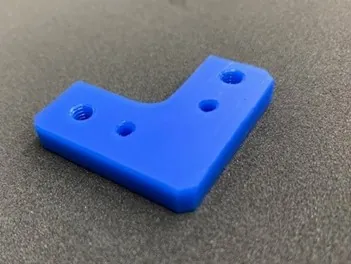
Structurally, MC Nylon is the same as nylon 6. So what makes it perform differently? The key lies in the manufacturing method — specifically, the timing of polymerisation relative to moulding.
Conventional nylon 6 has already completed its polymerisation before moulding. It is typically softened by heating pelletised nylon 6 and then shaped through processes such as injection moulding or extrusion.
MC Nylon, by contrast, is produced using the casting method: monomers are injected into a mould and polymerised at the same time. Because casting keeps material distortion far lower than other moulding methods, the result is a strong, high-performance nylon.
MC Nylon comes in several grades, each suited to specific applications. The most common grades and their properties are summarised below.
| Grade | Properties |
|---|---|
| MC901 | The basic grade of MC Nylon. This plastic excels in mechanical strength, wear resistance, heat resistance, and chemical resistance compared to standard nylon 6. |
| MC801 | Improves weather resistance by adding special graphite to MC901. Well suited to outdoor use. |
| MC703HL | A sliding grade with even greater self-lubricating and wear-resistant properties than MC901. |
| MC501CD R2 | Contains a special carbon blend that gives the material electrical conductivity. |
Colours and grades of MC Nylon
We tend to associate MC Nylon with the colour blue, but its original colour is actually white — the blue comes from added pigments.
The colour of MC Nylon can vary by grade. Manufacturers differ, but the following colour distinctions are generally used:
| Colour | Grade type | Example grades |
|---|---|---|
| Blue | General grade | MC901 |
| White | General grade | MC900 |
| Brown | Heat-resistant grade | MC602 |
| Black | Weather-resistant, conductive, etc. | MC501R2, MC501R6 |
| Purple, grey, green | Low-friction grade | MC703 |
Blue is the most common on the market and white is seen less often, but both are general-grade MC Nylon — the colour difference doesn’t change their fundamental properties.
Keep in mind that the link between colour and grade is a general trend, not a standardised specification across manufacturers. Always check the manufacturer’s catalogue or datasheet to confirm the grade and properties of the material you’re sourcing.
Advantages of MC Nylon
High impact resistance
At room temperature its impact resistance is moderate, but it improves as temperatures rise. MC Nylon is an excellent choice for components exposed to friction and wear, which makes it well suited to parts such as bearings and gears — components typically produced by CNC turning and CNC milling.
Resistance to organic solvents, alkaline agents, and oils
MC Nylon reliably withstands organic solvents, alkaline agents, oils, and fats.
High heat resistance
MC Nylon offers high heat resistance, allowing continuous use at temperatures as high as around 120 °C. Some heat-resistant grades can even be used up to 150 °C.
Lightweight and easy to handle
Combining low weight with high strength is a major advantage. This makes MC Nylon popular wherever lightweighting matters, including the automotive industry.
Disadvantages of MC Nylon
High water absorption and reduced dimensional precision
MC Nylon readily absorbs moisture, which can cause dimensional changes — especially in humid environments or when exposed to water. When designing MC Nylon parts, factor in possible dimensional changes both during storage and after installation.
Food hygiene compliance requiring soaking in boiling water
MC Nylon can contain impurities such as residual monomers and additives. To comply with food hygiene regulations, MC Nylon components must be soaked in boiling water for approximately 1.5 hours to remove these impurities.
Susceptibility to strong acids
Although it resists organic solvents, alkaline agents, oils, and fats, MC Nylon is notably weak against strong acids, particularly inorganic acids. Even at room temperature and low concentrations, using MC Nylon with inorganic acids is not recommended.
Despite these limitations, MC Nylon remains a valuable material. With careful grade selection and appropriate application, its drawbacks can be managed for most use cases.
Difference between standard, antistatic, and conductive MC Nylon
Standard MC Nylon offers excellent mechanical strength, superior wear resistance, and excellent dimensional stability. However, some applications require control of static charge or electrical conductivity — this is where antistatic and conductive variants of MC Nylon come into play.
- Standard MC Nylon: Non-conductive and insulating, ideal for general mechanical components where static charge is not an issue. Available in natural or blue tones, with excellent dimensional stability and superior wear resistance.
- Antistatic MC Nylon: Contains carbon-based or conductive fillers for moderate electrical conductivity and thus prevents static buildup. Surface resistances typically range between 10⁶ and 10⁹ Ω. It is particularly suited for applications such as powder transport, roller conveyors, or housings for electronic equipment. Machining properties resemble those of standard MC Nylon, although fillers may slightly increase tool wear.
- Conductive MC Nylon: Specially designed for high-conductivity applications where static discharge or grounding are critical. It typically exhibits lower resistance than antistatic MC Nylon (often ≤10⁵ Ω) and is usually black due to the high content of conductive additives. It is used in ATEX-certified areas, electronics manufacturing, and ESD-sensitive environments. Machining may require somewhat more robust tools to manage the higher abrasion from fillers; however, cutting speeds and feed rates are comparable to antistatic variants.
| Property | Standard MC Nylon | Antistatic MC Nylon | Conductive MC Nylon |
|---|---|---|---|
| Electrical conductivity | Insulating | Moderate (10⁶–10⁹ Ω) | High (≤10⁵ Ω) |
| Colour | Natural / Blue | Mostly black | Mostly black |
| Typical applications | General mechanical parts | Powder transport, conveyors, electronics | ESD-sensitive areas, ATEX zones |
| Machinability | Excellent | Slightly increased tool wear | Slightly increased tool wear, carbide recommended |
| Surface resistance | 10¹²–10¹⁴ Ω | 10⁶–10⁹ Ω | ≤10⁵ Ω |
When selecting between these variants, engineers must consider electrical requirements, operating environment, and tooling conditions. Standard MC Nylon offers the best machinability, while antistatic and conductive variants provide critical functionality wherever static-free surfaces or conductivity are required.
Conclusion
MC Nylon is a plastic that enhances the overall performance of nylon 6. Its fundamental structure matches nylon 6, but the Monomer Cast method produces a high-performance material with minimal deformation.
Its strengths include high impact resistance, excellent wear resistance, resistance to organic solvents, and good heat tolerance. On the other hand, it absorbs water — leading to dimensional changes — and is vulnerable to strong acids.
Beyond the basic grade, MC Nylon is available in several grades with additives that boost specific properties such as weather resistance or impact resistance. Choosing the right grade for your intended application is essential.